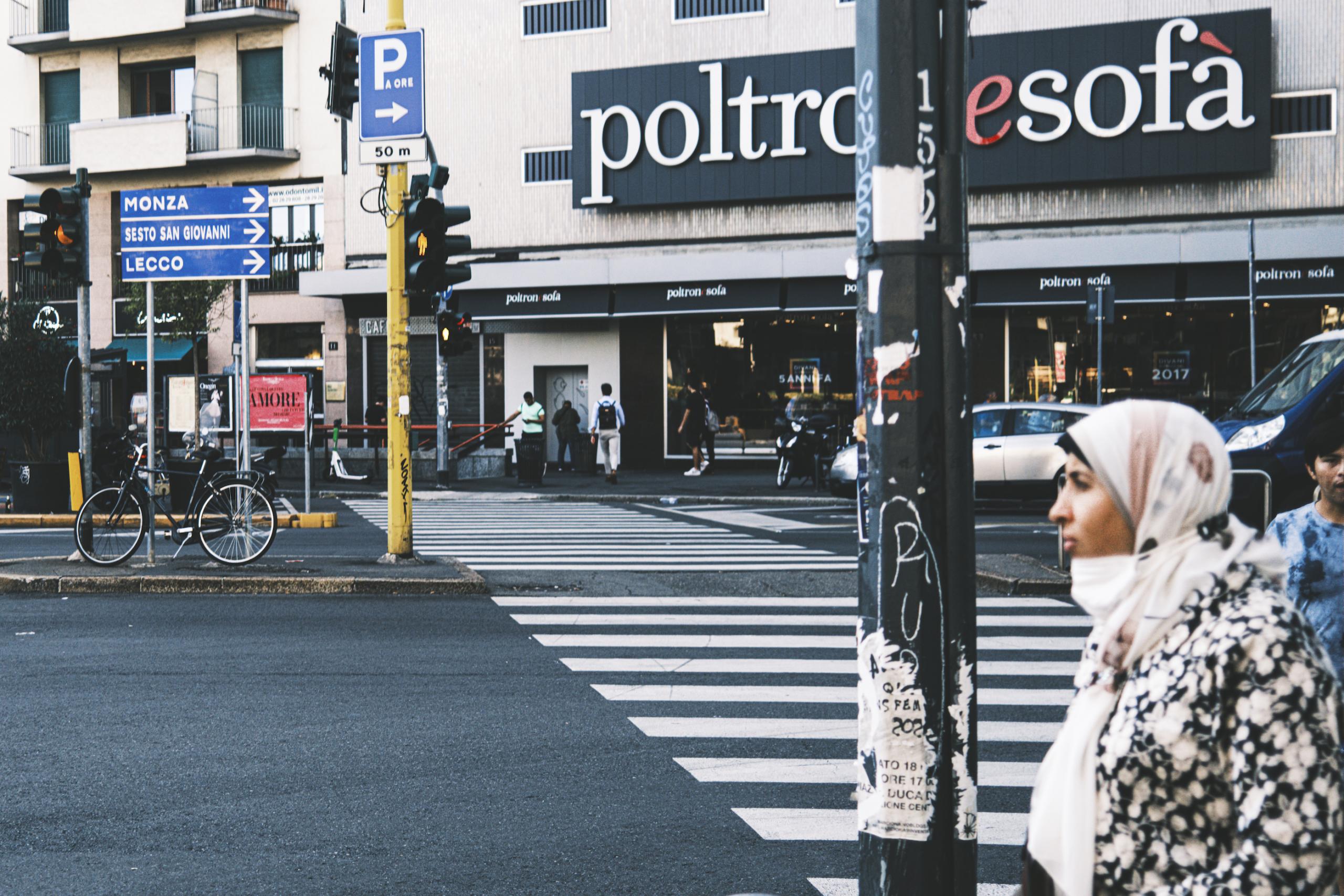
A person might be forgiven if they passed through and had no clue that it was on 29 April, 1945, that the lifeless body of Benito Mussolini was hanged at a filling station by partisans, a gruesome display foreshadowing Adolf Hitler’s suicide the following day.
I walked around the square in early April in the hope of taking in the historical significance of this fiery end to Mussolini’s regime, as well as the current moment.
On the 80th anniversary of the Allied victory, Italy stands in an awkward position. Prime Minister Giorgia Meloni isn’t just a sign of Europe’s far-right drift. Her ‘postfascist’ Fratelli d’Italia party is a nod to the Mussolini era, sullied by Antisemitism in its youth wing.
With Alternative für Deutschland’s meteoric rise in Germany, coming in second in the February election, and Meloni’s party continuing to poll ahead of the opposition in Italy, on this Liberation Day, one has to ask if the two former Axis powers ever got over fascism.
It’s never been clear to me, an American Jew, what Italian fascists are so mad about. They have a beautiful country full of art, food and natural scenery. Shouldn’t they just chill out and enjoy life? In today’s context, the answer is often about immigration.
“Meloni extended the maximum time limit for people held in deportation detention centres to 18 months and directed the construction of new centers,” reported the Harvard International Review, adding that she “also fundamentally changed how charity ships, boats operated by humanitarian organizations, operate in the Mediterranean—captains now face significant fines if they carry out more than one rescue operation at a time.”
The premier has tussled with the European Union over the status of Albanian refugees. The country has tightened ancestry requirements that one can invoke for applying for citizenship.
Meloni’s much-lauded call for more investment in Africa is a self-interested declaration to keep Africans from moving to Italy. Analysts debate her government’s success in living up to its anti-immigrant campaign promises. Still, she has tightened the borders in various ways and attempted to impede pro-immigrant activism.
A politics based on racial, geographic and national homogeneity–ensuring Italy is Italian–is farcical, and you don’t need to travel too far from Piazzale Loreto to see this.
Walking out of Loreto up Via Padova, one finds a street that might not seem out of place in New York or London’s most ethnically mixed neighbourhoods. Korean and Chinese grocers, South Asian barbers, and Arab-run halal butcher shops line the sidewalk.
Elsewhere, the vibrancy of “ethnic Italy” glimmers. Ethiopian and Turkish eateries sit seamlessly in the cityscape. It’s a living rebuke to Mussolini’s fascist nightmare.
On Via Paolo Sarpi in the heart of Chinatown, home to generations of Chinese Italians, people of all races congregate to enjoy a pedestrian walkway full of classic Asian food stalls. The connection between China and Italy is an old one, but Asia is embraced in other ways, as Italians are as crazy for ramen and sushi as they are for spaghetti and risotto.
On a tour with the Battleground’s Joel Schalit and Jennifer Crakow, I passed by Torino’s active synagogue, in a square named for Primo Levi, which is also home to a Syrian-Palestinian restaurant and an art gallery currently featuring photography from local Palestinian solidarity rallies. It all seems lovingly normal.
This is all to say that Italy doesn’t have a question of a multicultural future, because Italy, like other European states struggling with the return of the far right, has always been a multicultural place, a fact that should invalidate the central premise of nationalism.
One of the many things that separates fascism from other forms of authoritarianism is an obsession with blood and soil, that outsiders have physically corrupted the greatness of the nation.
Italian fascists might want to think twice before they fantasise about national purity. Many have genes linking them to other parts of the Mediterranean, including Africa, the Balkans and the Middle East.
Selwyn Raab, the late American journalist who covered the Mafia, posited that even the word Mafia may have derived from a mixture of Sicilian and Arabic, a result of the constant conquest of the island.
The tomato and the potato, which so helpfully define Italian cuisine as one of the best in the world, come from the New World, and those espresso beans Italians love so much don’t grow anywhere in Europe. Many other Italian dishes, even the pizza, might have Western Asian roots.
Centuries of trade, settlement and movement define all aspects of our lives. In this sense, fascism’s goal of national purity is an unattainable fantasy, a dream of a past that never was and a future that never could be.
What the fascist mind can’t tolerate is that a great many people actually like a world where they can stroll up a street like Via Padova and sit in the richness of an international hub because this is the essence of humanity.
The left finds that it has to defend immigration not just to the political right but to social democratic leaders like Danish Prime Minister Mette Frederiksen and Sahra Wagenknecht, formerly of Germany’s Die Linke, who left to start her own party, the unsurprisingly named Bündnis Sahra Wagenknecht, mixing left and right politics.
In doing so, leftist parties often campaign for the rights of immigrants on broad policy grounds: the Global North has a responsibility to take in refugees from wars and economic catastrophe, often caused by imperialism and capitalism. Modern economies depend on immigration for growth. Conventions on human rights and movement should be respected.
These are good arguments, but the left should make a more philosophical point: borders and national homogeneity are antithetical to human civilisation. In a highly entertaining debate, Greek left-wing economist Yanis Varoufakis made such a case to Freddie Sayers, the editor-in-chief of the right-wing British publication UnHerd.
We need more of this, especially as we reflect on the anniversary of the defeat of fascism, because to defeat these monsters again, we have to expose how unnatural their fantasies really are.
Please support The Battleground. Subscribe to our free newsletter and make a donation to ensure our continued growth and independence.
Photograph courtesy of Joel Schalit. All rights reserved.