The Franco-Brazilian artist doesn’t need the strident dynamics of punk to make a point.
Gildaa refuses to be pigeonholed. A single song can race through multiple subgenres without losing the thread, creating a fusion that transcends them all.
On “Perséphone”, her voice explores the territory of “singing in cursive,” ranging between jazz and pop idioms to the accompaniment of varied EDM rhythms.
“Soul Sister” has a grittier R&B feel, its throbbing beat offset by a strange chorus in which Gildaa harmonises with herself.
The music never feels cluttered. Each element has room to breathe, creating a vibe similar to Portishead’s first album, which exploded the trip-hop category by establishing it.
Gildaa packs a lot of words into her songs, almost as if she were rapping. But none of them is superfluous.
Not only do her lyrics bear a heavy semantic load. They also signify in ways that go far beyond their dictionary meanings. Her voice communicates subtle nuances that complicate the musical experience.
On “Utopistes”, for example, she repeats the same lines—a de facto chorus—three times, but intones them differently enough on the final repetition to make listeners question their initial interpretation:
Les mêmes discussions
Les mêmes réflexions
Les mêmes désir de changer
Although the majority of Gildaa’s lyrics are in French, she also has songs in Portuguese and English.
Deciding in which language to sing used to be a difficult decision. Even selecting a global language like French could substantially impact an artist’s potential audience. English was that dominant.
But once lyrics became widely available online – many Bandcamp artists make theirs available – and passable translations could be obtained in seconds, the pressure to choose correctly eased.
Not only does this help artists whose native language is not a global powerhouse. It also encourages them to switch between tongues.
The other day, after listening to GILDAA several times in a row on my laptop, I grabbed my CD of Electrelane’s 2004 album The Power Out to hear on the car stereo while running errands.
I had forgotten that it features lyrics in French, Spanish, and German in addition to English. Back when the album came out, this code-switching was a significant impediment to comprehension. Now, by contrast, it makes artists like Gildaa more intriguing.
Instead of providing answers, GILDAA poses questions.
Gildaa avoids the sloganeering of self-consciously engagé artists. Indeed, her songs consistently repudiate the idea of ideological certainty.
She is not yet a major artist from a commercial standpoint. Most of her songs on Spotify have well below 50K views. Yet that doesn’t stop her from acting like one.
In particular, the videos made to accompany the album’s songs belie the fact that she is a comparative newcomer. It’s not just that they look so professional, comparable to what platinum-selling artists do. They are also thematically complex.
This shouldn’t come as a surprise, given that the video for Gildaa’s song “Pas Assez” had already won a prize at the Cannes Film Festival years before she released the first single from her debut album.
That video already demonstrates Gildaa’s remarkable facility for merging aesthetics and politics in unconventional ways.
The first part shows a wide variety of women queuing up for a casting call. We then see Gildaa auditioning before a frightening panel of judges, who repeatedly indicate that she is falling short of the mark, either because she is too little or too much.
The most conventionally masculine member of the panel then makes two disturbing demands, his voice suddenly in a low, rumbling register that conjures the devil: “Give me your soul. Give me your ass.”
After Gildaa responds with confusion, we cut to a rapid-fire montage in which close-ups of a diverse group of women—the same ones we saw queuing up at the beginning of the video—accompany a long series of negative questions: “Not black enough? Not Arab enough? Not Asian enough? Not Jewish enough? Not big enough? Not thin enough? Not athletic enough?” etc.
This litany of defects concludes with Gildaa declaring, “Not white enough,” before breaking into a tight-lipped smile reminiscent of the inscrutable Mona Lisa.
In the final portion of the video, we are transported to what appears to be a windowless parking garage, where the same women from before are dancing wildly. The cutthroat competitiveness of the casting call has given way to exuberant solidarity, culminating in a shot of naked bodies that do not fit the stereotypes of the fashion and fitness industries.
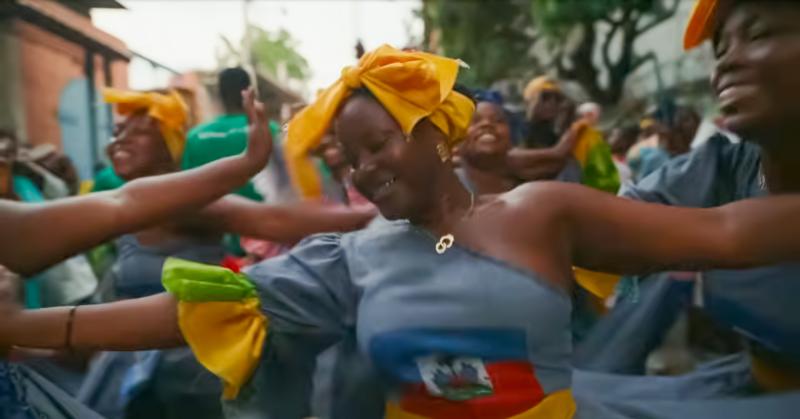
The video for “Tout pour plaire”, one of the singles on GILDAA, ends in a similar fashion, as we watch the artist enter the crowd in a theatre, then blend into her own audience as a similarly diverse group of women dance to wild applause.
Both videos celebrate multicultural feminism while implicitly critiquing its corporate manifestations.
I couldn’t help but think of Sephora, the French chain devoted to make-up, sales, whose walls are festooned with images of diverse women looking their best thanks to the expensive products that adorn their faces.
These Gildaa videos cast a spell on these mute images, animating them with a potent mixture of menace and doubt.
While her lyrics undoubtedly reinforce the positive feminist message of these videos, they do not shy away from uncomfortable contradictions.
One of the most troubling moments on GILDAA is when she sings, in English, “Treat me like a child” and then follows it up immediately with “Don’t treat me like a child.”
Desire isn’t rational. It disobeys our commands and takes us places we are both afraid and excited to go.
So does Gildaa, an artist destined for great things because she is comfortable with her own discomfort. And ours.
Photograph courtesy of Joel Schalit. All rights reserved.