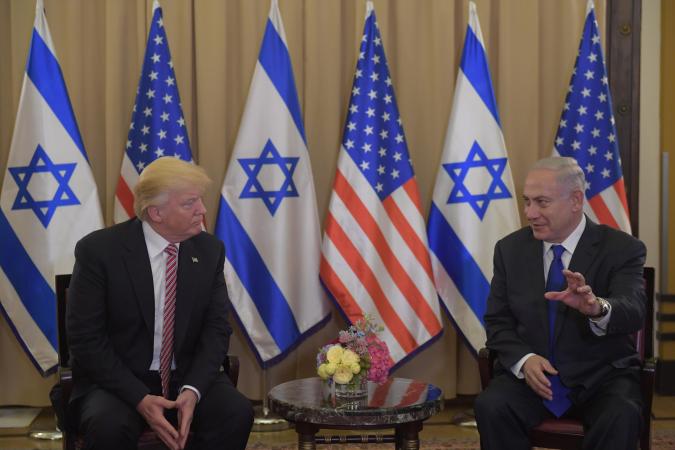
As though on cue, Israeli Prime Minister Benjamin Netanyahu appeared on American television, warning that Türkiye was “a regime that’s infected with the Muslim Brotherhood, which hates the United States”.
The comments came as Trump was strongly considering lifting a ban on the sale of American F-35 fighter jets to Türkiye. The sale of those jets was banned in 2020 due to Ankara’s purchase of S-400 anti-aircraft missiles from Russia.
Israel has long portrayed Türkiye as a growing security concern, citing Ankara’s support for the Palestinian cause.
More fundamentally, however, Israeli leaders appear concerned by Türkiye’s military capabilities and expanding regional influence amid an increasingly adversarial bilateral relationship.
Türkiye’s defence industry has begun to rival Israel’s; in 2025, defence exports reached $10.5 billion, more than half of Israel’s that same year, particularly to countries such as Ukraine, which it refuses to arm, despite repeated requests from Volodomyr Zelenskyy.
Now, the power behind Syria’s new government, having trained and armed its military, with Turkish troops occupying significant parts of northeastern Syria, Israel has a new regional competitor, albeit one that’s been years in the making.
In February, former Prime Minister Naftali Bennett, who is hoping to either regain that office or secure a prominent place in a potential post-Bibi government this October, identified Türkiye as a threat that should frighten Israelis as much as Iran does.
“A new Turkish threat is emerging. We must act in different ways, but simultaneously against the threat from Tehran and against the hostility from Ankara,” Bennett said.
Like Netanyahu, Bennett also used the Muslim Brotherhood to scare people about Türkiye. “Qatar and Turkey, which is based in Syria and, with Israeli consent, in Gaza, are feeding a new monstrous axis of the Muslim Brotherhood similar to the Iranian one.”
Does Türkiye Pose a Threat to Israel?
Türkiye is a perfect example of Israel’s approach to its foreign affairs.
Ankara has long been a critic of Israel’s policies towards the Palestinians and has maintained that criticism through periods of relatively good relations between the two countries as well as frequent periods of tension.
The two countries have never engaged in armed conflict, not even by proxy.
But Türkiye, and its president Recep Tayyip Erdoğan, have diplomatic relations with Iran and have made it clear that they regard Hamas as a legitimate resistance movement, not a terrorist organisation, and that they have a substantive claim to representing the Palestinian people.
Understandably, that does not endear Ankara to Israel, but it is far from a threat of war.
Yet Israel is determined to portray Türkiye as an imminent threat to its very existence, much as it often exaggerated the Iranian threat, another country that never directly attacked Israel before Israel attacked it.
The main difference is that where the bombastic style of Iranian leaders often made it easy to take their words directly and read them as threats when they were meant as hopes for the disappearance of the “Zionist entity,” Türkiye is more conscious of Israel’s ability to build a wall of propaganda.
So, Israeli public diplomacy must work harder to create the illusion that Türkiye seeks to destroy Israel.
When Turkish Foreign Minister Hakan Fidan said that Israel had “… become a burden that humanity can no longer bear”, it prompted a wave of outraged hysteria.
Unlike Iran, Türkiye seldom presents an opportunity for such wilful word games, so Israeli Foreign Minister Gideon Sa’ar responded quickly, saying:
Turkish FM Hakan Fidan’s sickening words are textbook incitement to genocide. Dehumanising the Jewish people as an ‘unbearable burden’ is the classic, horrific language of history’s worst eliminationist regimes. The civilised world and Turkey’s NATO allies must unequivocally condemn this explicit call for the erasure of Israel.
But this was not a call for genocide.
It was an attack on the international community for bending over backwards to accommodate Israel’s conduct in Gaza, Lebanon, Syria, Iran, and elsewhere.
And it was a demand for diplomatic action and sanctions, stating that “the human conscience cannot bear it” and that “political systems cannot sustain it, and economic systems cannot sustain it”.
Never one to let the facts get in the way of a good piece of propaganda, Bibi also ripped into Fidan’s words, saying, “(Erdoğan’s) foreign minister… said that the Jewish state hasn’t a place among humanity. Basically, it has to be wiped out.”
Fidan said nothing of the kind. He did, however, use forceful language in saying that the world must take concerted action against Israel.
The prospect of genuine international pressure to end Israel’s denial of Palestinian rights, its occupations of Lebanon and Syria, and its impunity to attack any country in the region whenever it wishes frightens Netanyahu, Sa’ar and the rest of the Israeli government (and most of the opposition) far more than any threat of a military attack.
Planting anti-Türkiye Seeds in Washington
This is a long-term process. At the moment, it is inconceivable that Israel could pose any significant military threat to Türkiye, a NATO member in good standing.
However, if a campaign to demonise Türkiye takes hold and is sustained for years, the equation can change, especially given the lack of a guarantee of NATO’s long-term survival.
It is unlikely to resemble the campaign against Iran, since Türkiye does not have the anti-American history that Iran, quite understandably, has in the wake of American efforts to undermine Iranian democracy after World War II and of its long support for the Shah’s brutal dictatorship there.
While it will certainly take a different form, the campaign to alienate Türkiye and enable Israel to call on Western help to isolate it is already underway.
Türkiye already has significant detractors in Washington, and while it has a long, mutually beneficial relationship with the US, it lacks the lobbying influence and financial investment that other Muslim states, such as Saudi Arabia and the United Arab Emirates (UAE), do.
Erdoğan is well-known as an authoritarian ruler. Bibi used that in his interview with CNN this week, citing, accurately, the fact that the Turkish leader jails opposition figures and journalists.
He failed, however, to note that Israel also routinely jails Palestinian leaders, often without charge. And, while Israel also sometimes jails journalists, it much more often kills them.
Netanyahu’s criticism of Erdoğan should be taken with a grain of salt. But a double standard for Israel is hardly a novelty in Washington.
Thus, we saw congressional Democrats introduce a Joint Resolution of Disapproval to impede the sale of the F-35s to Türkiye.
The case they made is worth noting.
The bill’s author, Rep. Dana Titus of Nevada, explained that she introduced the resolution because:
Turkey already is destabilising the region with its continued illegal occupation of Cyprus, antagonism toward Greece, close association with designated terrorist organisations, support of Azerbaijan’s campaigns against Armenia, and threats to invade Israel. We should not be rewarding Erdoğan’s bad behaviour by expanding Turkey’s military might.
The hypocrisy is breathtaking. Israeli leaders have explicitly threatened to target Türkiye. Yet House Democrats fight tooth and nail to continue sending an overwhelming number of weapons to Israel, not as sales but as grants.
Given that the legislators who introduced this resolution are among the most hawkish pro-Israel Democrats in the House, it is not difficult to see the ideological motivation at play here.
And they are not alone. A bipartisan letter led by Republican Mike Lawler of New York and Democrat Brad Sherman of California echoes the Joint Resolution’s talking points.
After touching on the issue of Cyprus, the letter reads:
There is constant and growing anti-Israel rhetoric, all while Turkey maintains bilateral relations with Iran. While Turkey has been a NATO ally since 1952, they have hardly been a reliable partner in the present day.
Rhetoric critical of Israel is hardly unique to Türkiye.
It’s important to recall that diplomatic relations, which had been severed over Israel’s killing of nine Turkish activists and its deliberate humiliation of a Turkish diplomat, had been restored before shattering again following a Turkish protest against the genocide in Gaza in November 2024.
It’s worth noting that this was not a knee-jerk reaction by Türkiye but a decision made after the genocide had been ongoing for over a year and after Israel had rebuffed numerous efforts by international actors to end it.
Regarding Türkiye’s bilateral relations with Iran, one must ask why this is not a concern for these members of Congress, given that it is not a concern for Oman, Qatar, Saudi Arabia, Pakistan, Armenia, Azerbaijan, Jordan, Denmark, Finland, South Korea, Japan, and scores of other countries.
Clearly, the stated reasons are false. The real reason is simple. Israel will not tolerate a state with a strong military, its own regional ambitions, and the ability to pursue them.
For those in Washington who see US foreign policy through a pro-Israel prism, American and Israeli interests have become virtually inseparable.
The result is a policy trajectory that increasingly reflects a goal long held by much of Israel’s political leadership. After Iran, Türkiye becomes the next strategic focus.

Photograph courtesy of defense.gov. Published under a Creative Commons license.