Surprisingly, this is as true today as it was when the picture came out in 1974.
Most films that sparked controversy at release lose their edge over time. When older ones trouble us now, it’s usually because of what they take for granted, pushing buttons that their creators never considered.
The Night Porter is different.
The setting is Vienna in 1957. Unlike in Berlin, the Allies’ occupation of the city had ended by then, making it easier for those who enthusiastically supported the Third Reich to navigate civil society.
At the Hotel zur Oper, a group of former Nazis and collaborators meet regularly to discuss their efforts to avoid being prosecuted for their wartime actions. One of them is Max, portrayed by Dirk Bogarde, who runs the hotel’s night desk with a mixture of ruthless efficiency and refined manners.
Their routine is disrupted when one of them thinks he sees a familiar face, an inmate from the concentration camp where members of the group came to know each other. She is travelling with her husband, a classical conductor, on a concert tour of Europe and is staying at their hotel. Flashbacks show us how Max singled her out for special treatment at the camp, coercing her into a sexual relationship in which she eventually reciprocates his feelings for her.
At first, Max’s primary concern seems to be that she will expose his past to the authorities. But once he confronts her in person, he realises his primary concern is finding a way to resume their relationship, despite the danger it poses to everyone in the group.
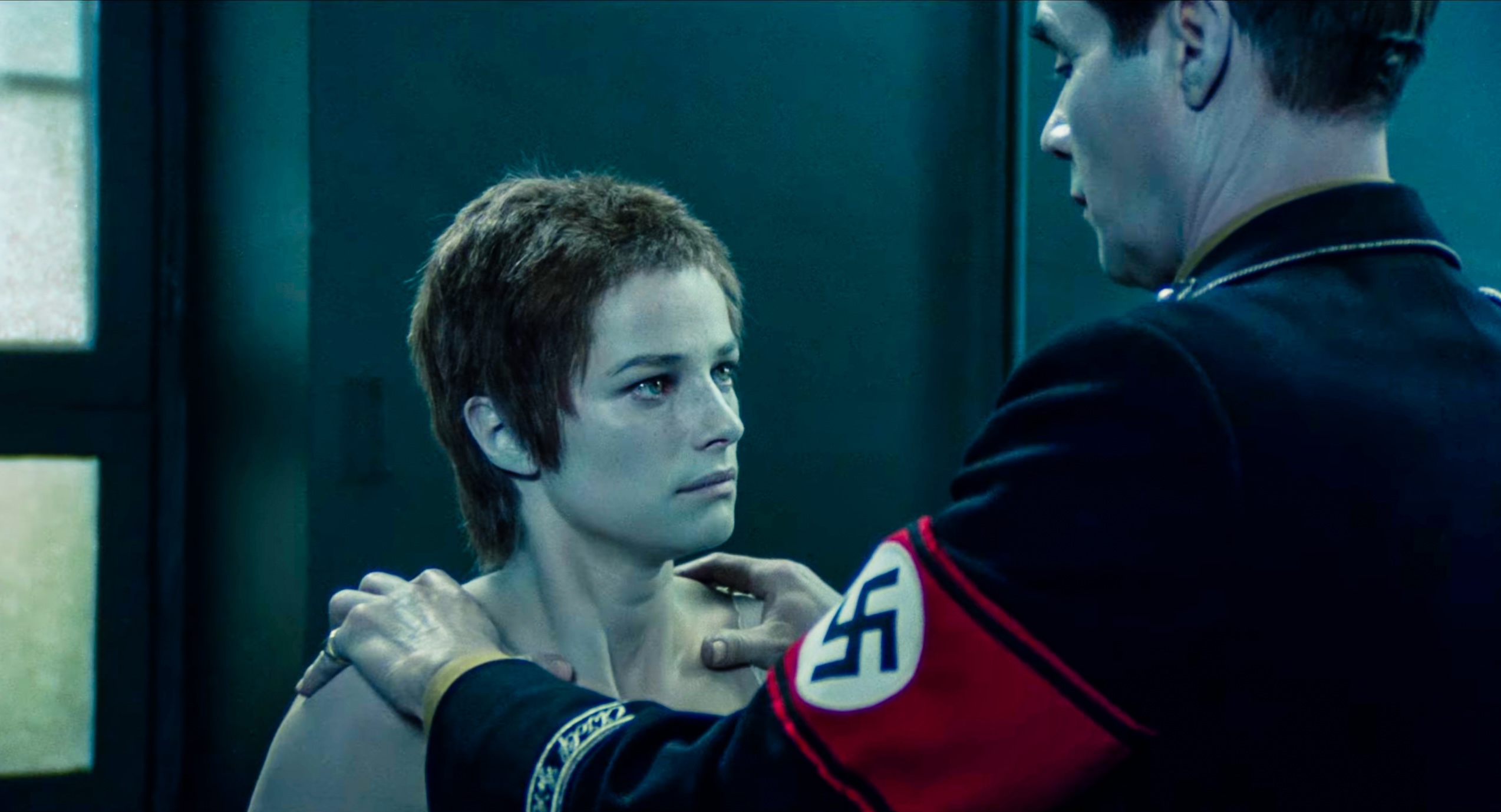
Although Lucia, fearlessly played by Charlotte Rampling, initially seems terrified at the prospect of even seeing Max and enraged when he enters her hotel room without permission, she quickly reverts to the sadomasochistic dynamic that characterised their relationship in the camp. She sends her husband a telegram telling him that she cannot join him for the remaining stops on his tour and moves into Max’s apartment.
The flashbacks prominently feature the SS uniforms, including their iconic swastika armband, that by the late 1970s had already become a staple of extreme pornographic scenarios.
In one scene, Lucia performs a cabaret number, Marlene Dietrich-style, wearing only an SS commander’s hat, braces, and a man’s dress pants, as if she were doing a perverse striptease. The climax features her opening up a boxed gift from Max featuring the severed head of another inmate who had been harassing her, retroactively turning her into an unwitting Salome.
The film builds towards a harrowing conclusion in which Max and Lucia hole up in his apartment. She is his prisoner, again. And he is the prisoner of the other Nazis in his group, who are intent on eliminating a witness who could implicate them all.
As their food supply dwindles and threats from outside mount, their world shrinks to their fixation on one another.
While Lucia is the victim of Max’s obsessive and abusive behaviour, just as she was in the camp, she has apparently lost interest in everything else. Her traumatic bond with him is so strong that it breaks all others.
To make matters worse, even though Dirk Bogarde wasn’t known for having heterosexual chemistry with his leading ladies, something about the desperation in Max and Charlotte Rampling’s interactions combines with his uniform to make him downright sexy, simultaneously domineering and vulnerable.
Towards the end of the film, a desperate Lucia dips her fingers into their remaining jar of jam. When Max tries to take it from her, it falls to the floor and shatters. This doesn’t stop her from eating it, running her tongue over the jagged shards. Then he joins her, for a fitful embrace in which the jam becomes indistinguishable from their blood.
It’s an extremely dark scene, reminiscent of the concluding moments of the surprise hit horror film Obsession and similarly indebted to the Liebestod (“Love Death”) immortalised in Richard Wagner’s opera Tristan und Isolde.
While it may be hard for viewers to believe that someone who had suffered like Lucia would make no effort to escape her bondage, there is a vast amount of evidence that women in abusive relationships find it difficult to extricate themselves.
The male critics who lambasted The Night Porter may not have had the courage or self-awareness to recognise that Cavani is presenting Lucia’s tale as a limit case, showing how far victims of abuse will go to stay with their abusers.
They also seemed to have misunderstood the film’s prescient allegorical implications.
Postwar Germany and Italy went to great lengths to distance themselves from the fascist states that preceded them. This included everything from executing or imprisoning leaders to banning symbols, slogans, and coded messages designed to circumvent the ban.
Although this seemed like a reasonable response at the time, the fact that it went hand in hand with a proliferation of content about fascist Germany and Italy undermined its effectiveness. You couldn’t dress as a brown or black shirt, but you could perversely enjoy them in films, television programs, and comic books.
Pretending that fascism had been vanquished forever while its iconography saturated popular culture turned out to be a serious mistake.
While an officer in the British Army during the war, Dirk Bogarde had been among the first troops to enter a concentration camp. That experience made it particularly hard to play Max and amplified his horror when, while shooting outdoor scenes for The Night Porter, bystanders cheered him for wearing an SS uniform.
Cavani was of a similar mind.
She spent the 1960s making television documentaries. The first traced the rise and fall of the Third Reich. The next was a political biography of Joseph Stalin. Then came one about women who participated in the Italian Resistance during World War II.
These experiences gave her keen insight into the horrors of totalitarianism. She did not arrive at the story of The Night Porter lightly. Whatever buttons the film pushed, she wanted to push them.
This is why she made sure that Charlotte Rampling’s character was the daughter of a socialist rather than a Jew. It’s much easier to imagine her seeking perverse satisfaction at her father’s expense as someone who occupied a comparatively privileged position in her concentration camp.
As Cavani regretfully acknowledged, many people who reacted strongly to the film overlooked this crucial detail, including professionals who focused on the story they feared they were seeing instead of the one The Night Porter actually tells.
Predictably, the film received negative press coverage, particularly in the United States, where many prominent newspaper critics were Jewish.
It’s not hard to see why.
The singularity of the Holocaust derived from a determined effort to prevent it from fading into the background like other historical atrocities had. And this required that the unspeakable crimes of the Third Reich be personified. Once it’s hard to picture concrete villains or their representation becomes too complex to yield the necessary caricatures, the door to relativistic thinking is pried open.
While The Night Porter certainly doesn’t turn Max into a hero, it humanises him. Because his character focalises the narrative, it’s difficult for audiences to avoid identifying with him to a degree, even if they have been trained to regard Nazi iconography as the ultimate index of evil.
Charlotte Rampling’s character further complicates matters. Sometimes she is repulsed by Max and what she did to please him in the camp. Other times, however, her desire for him overwhelms that negative response. Indeed, we get the distinct impression that her repulsion magnifies her need for him, accentuating the role-playing that turns her on.
What did Liliana Cavani want to achieve with The Night Porter?
It’s not a film about logic. Cavani explores the irrationality of desire, decisions that would not make sense to a dispassionate observer.
Nothing suggests that her political convictions had changed in the decade since she began making television documentaries. She was a principled leftist, not one of those postwar Italians biding their time until the legacy of fascism could once again be examined with a “fair and balanced” perspective.
Cavani was no shallow provocateur.
In her documentary about women in the Italian Resistance, Cavani asks what led them to risk their lives. Her subjects consistently frame their actions as a collective struggle. They were doing their part, when every part was potentially crucial.
The Night Porter repeatedly shows Lucia in the company of other prisoners, most of whom appear to be in much worse shape than she is. We witness her being singled out for special treatment.
This depiction suggests that, unlike the women of the Resistance, Lucia rejects the collective to strengthen her individual position, as collaborators did throughout German-occupied Europe.
But if The Night Porter were simply a tale of selfishness, it would not resonate so powerfully. Lucia’s individual situation mirrors that of the eponymous night porter, whose desire for her complicates his duties, both at the hotel and with his group of former Nazis.
The first half of the film communicates dread over “relapsing” on multiple levels. The cadre of former Nazis and collaborators dream of being able to act the way they did during the war. Lucia clearly fears that she will revert to the role she played in the camp. So does Max, in a different way.
If we think of the remainder of The Night Porter in these terms, as a tale of falling off the wagon, Cavani’s decision to make the film takes on a different aspect, one that is even more useful today than it was when the film came out.
During the postwar era, we became too dependent on representations of fascism. Nazis made ideal villains. And their counterparts in Italy weren’t far behind.
Unfortunately, the heart and the head rarely align. Just as Lucia lacks the will to resist her former abuser, we collectively succumbed to the seductions of depravity. To make matters worse, we self-righteously believed that moral clarity on who the bad guys were would neutralise their power.
The depressing truth is that the opposite happened.
Screenshot courtesy of The Night Porter. All rights reserved.