


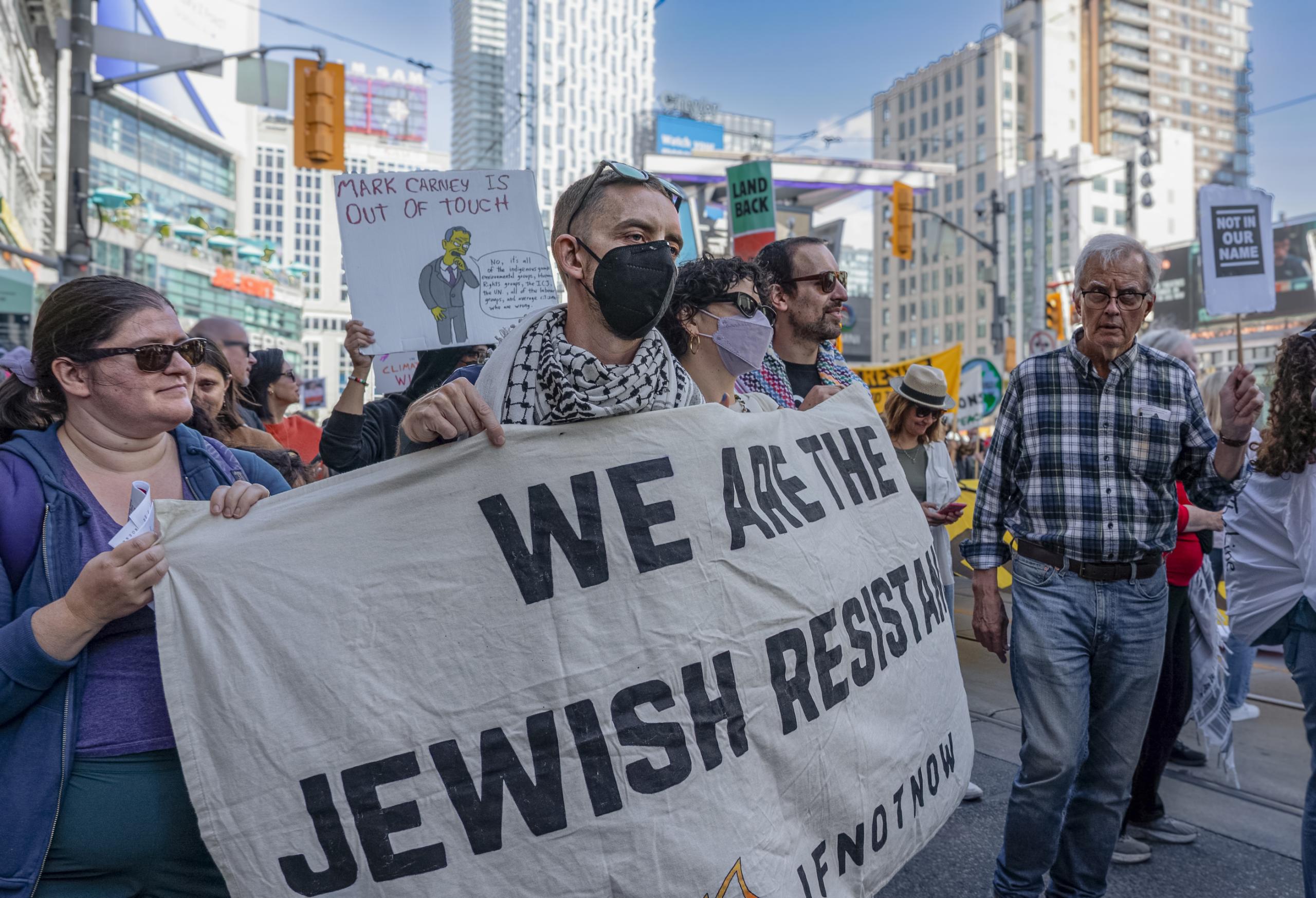
The Day of Atonement calls on Jews to confront and repent of our sins over the past year. Much of the Yom Kippur liturgy is spoken in the plural, indicating that the holiday is meant not only for personal reflection but also for communal introspection.
In that spirit, Lewis, who has always embraced his Jewish heritage, sent this message:
Tonight Yom Kippur begins, the most sombre moment of the Jewish calendar. It’s a time of atonement – a time to grieve those who have been lost, a time to acknowledge and take responsibility for harms we have caused, individually and collectively. For Jewish people, the personal has always been political and the political always personal. This year I’m reflecting on the fact that we failed to do our part to stop an ongoing genocide committed in our name. There are many other fronts where I have to do the work of repair. But nothing on this scale.
Several Liberal Party members of Canada’s parliament assailed Lewis for allegedly blaming all Jews for Israel’s actions.
Clearly, that isn’t what he said. Lewis was pointing out that Jews who oppose Israel’s genocide in Gaza have failed to stop it.
Our community has been divided, and, unfortunately, in Canada and elsewhere, those opposing the genocide have often lacked sufficient power and numbers, even as so many around us have condemned Israel’s actions.
Jewish opposition to Israel’s policies has been evident and vocal. Yet, although we support many Palestinian, Muslim, Arab, progressive, and activist voices, we have not succeeded in influencing Israel’s policies or convincing our governments to hold Israel accountable.
The situation calls for us to acknowledge reality and work to improve it. Lewis expressed regret over our failure to prevent the violence, but did not blame us for it.
Those criticising Lewis may be acting dishonestly, or they might have misunderstood his words as blaming all of Canada’s Jews for Israel’s actions.
Jewish Opposition to Jewish Complicity
But the controversy raises important questions about the Jewish diaspora and Israel’s crimes that remain unaddressed beyond the most superficial level.
It is, of course, axiomatic that Jews, as Jews, cannot be blamed for Israel’s crimes. Israel’s claim to act in the name of world Jewry is a fiction, as millions of Jews around the world object to Israeli policies.
These disagreements range from supportive criticism to outright opposition to Zionism and the state it created. As such, it is obviously unfair and, yes, Antisemitic to assign collective blame to Jews.
By the same token, it is Antisemitic for Israel and its supporters—Jewish and non-Jewish—to claim that Israel represents the Jewish people collectively.
Even calling itself a “Jewish state” is a misnomer, as it reduces the Jewish people to a nationality, a narrow view of Jewish existence among a range of definitions the Jewish people have for ourselves.
The Israeli-Zionist version is neither exclusive nor definitive, and is passionately disputed by Jews worldwide.
But the fact that Jews cannot be blamed collectively for Israel’s crimes does not absolve the very real responsibility of significant parts of the Jewish diaspora that play an indispensable role in enabling those crimes.
When a synagogue proudly displays a huge billboard proclaiming “We Stand With Israel” while Israel is slaughtering tens of thousands of Palestinian civilians, it cannot then hide behind its identity as a “place of worship” to shield itself from backlash.
When a Jewish community centre hosts an event promoting the purchase of stolen Palestinian land in the West Bank, where Jewish-only settlements are being built, it cannot then claim to be beyond blame for settler violence in the West Bank.
When groups such as AIPAC, the Anti-Defamation League, the American Jewish Committee, the Republican Jewish Coalition, the Jewish Democratic Council of America, Canada’s Centre for Israel and Jewish Affairs, the Middle East Forum, the Zionist Organisation of America, the Board of Deputies of British Jews, the European Jewish Congress, ELNET, and many other Jewish and pro-Israel organisations raise funds in synagogues and Jewish communal spaces to support their lobbying, they cannot later deny responsibility for the crimes they are facilitating.
These groups use Jewish identity and Jewish historical suffering to empower Israel to defy international law, maintain its occupation, and deny Palestinians the most basic rights, including the very right to continue living.
It is intolerable that they should shield themselves from criticism by claiming they are not responsible for Israel’s actions.
Lewis’ Lament
Not long after Avi Lewis made his controversial tweet, a former Canadian soldier attacked a synagogue while the congregation was inside, observing Yom Kippur.
His motives apparently had nothing to do with Israel and stemmed, like the overwhelming majority of Antisemitism, from xenophobia and violent, racist white nationalism.
Following the synagogue shooting, where a police officer was injured and the attacker was the only person killed, Lewis faced accusations of contributing to an environment that fostered such violence.
Lewis responded, “It’s pretty ugly to see these partisan points being — this occasion, being used to score partisan points,” he said. “Holding Jews collectively responsible for the actions of the state of Israel is antisemitic. I’ve never done it. I think it’s dangerous and that’s absolutely not what I did. I spoke as a Jewish Canadian from a place of profound sadness.… Many Jews have said that we have not done enough as Jewish people, among a family of faiths and communities around the world.”
Beyond Lewis’ response to the accusations, it is worth noting the words of John Allen, the former Canadian ambassador to Israel, who is also Jewish.
“By not calling out what’s happening in the West Bank and Gaza, there is a complicity of silence,” Allen told a Senate committee this past June. “The failure sometimes, frankly, of the Jewish community” to speak out against Israeli government actions “makes people in Canada say, ‘Well, do they support everything Israel does? Do they support what happened in Gaza?”‘
Where Allen falls a bit short is that he fails to parse the “Jewish community.”
As anyone knows, Jews are far from a monolith. In Canada, the group Independent Jewish Voices has spoken out passionately against Israel’s genocide in Gaza and its terror attacks against Palestinians on the West Bank, mirroring Jewish dissent all over the diaspora.
However, Allen’s more significant point is crucial but insufficiently discussed.
Political views and activism never justify violence. It is unacceptable and criminal to attack Jews for Israel’s actions or to assault supporters of Israel for the country’s crimes physically.
Just because individuals or groups must be able to voice their opinions, even if they are objectionable, without fear of random or state violence doesn’t mean they are exempt from accountability or the obligation to respond to their speech.
Lewis’ lament about failing to prevent genocide in Gaza and the ongoing ethnic cleansing in the West Bank urges Jews of conscience to redouble their efforts, enhance their actions, and recognise that we occupy privileged positions in discussions about Israel, granting us greater influence than our allies.
Allen highlights the contrasting side of the issue, urging us to more explicitly oppose the forces within our community that back the genocide. He points out that while some groups openly support it, others do so more quietly.
Jews of all backgrounds often feel justifiably angry when they hear people downplay or deny the Holocaust. This anger stems from the insult to our ancestors’ suffering, some of whom are still alive today. It also causes fear, as minimising that atrocity raises the risk that such horrors could recur.
Holocaust denial is an attack on history. But how much worse is it to deny a genocide while it is still unfolding?
This denial manifests in different ways. Some refuse to acknowledge it at all, while others downplay or justify the mass killing of Palestinians by Israel.
Some twist reality and claim that the genocide is the responsibility of Palestinians themselves.
Some people turn the entire discussion into a theoretical debate about whether these deaths qualify as genocide. Still, they overlook that tens of thousands of children who have died are unconcerned with how their deaths are labelled.
Even these rhetorical activities aim to minimise, justify, and sanitise Israel’s crimes. Denial helps governments avoid action and hinders political efforts to stop Western support for Israeli crimes, if not prevent them entirely.
But the pro-Israel Jewish community does more than express an opinion.
The ongoing fundraisers for the Israeli Defense Forces, charities supporting Israeli settlements, or lobbying groups that prevent accountability and keep weapons flowing to Israel—none of this can be justified simply by the principle that all Jews should not be blamed for Israel’s actions.
Since many might falsely repeat these statements, no political reason justifies attacking a synagogue. Even if one were completely sure that all inside had supported a pro-Israel group, it would still not justify any violence, especially lethal force.
But while violent responses are absolutely forbidden, protest, criticism, outrage and other forms of social, cultural, and political opposition are not just fair game; they are moral imperatives.
That’s what Lewis is saying. There are already considerable forces working politically to change policy, and part of that is shining a light on those supporting genocide.
No Jew, Muslim or person of any faith should be targeted for that faith. Nor should anyone be targeted for violence for taking a political stand, even an unpopular or abhorrent one.
People should not hide behind their faith after taking a political stance, especially when facing justified criticism. This principle applies to all politics, but it’s particularly crucial when individuals defend acts of genocide.
Avi Lewis was calling on anti-genocide Jews to do better because the genocide continues.
Supporters of the Gaza genocide should also stay true to their beliefs and accept the verbal and political backlash that their stance provokes, just like opponents of Israeli policy do daily.
Photograph courtesy of Eric Parker. Published under a Creative Commons license.


