Despite the sudden wall of noise, I recognised “Thumb” immediately. But my anticipation went beyond that.
Compared to many of my favourite artists, Dinosaur Jr.’s lyrics seem like an afterthought, there because the genre requires them. Yet I have pondered some of them longer and harder than most.
Part of that has to do with their paucity. The instrumental portions of Dinosaur Jr. songs last longer than is typical for rock bands of their era, placing greater emphasis on the words they do contain.
The main reason I have fixated on them, however, is their self-reflexivity. Song after song, they reflect on the difficulty of connecting through language. In lamenting how words inevitably miss their mark, they come closest to hitting it.
The second line of “Thumb” is a great example.
When Mascis sings that there’s “always nothing much to say”, he makes it clear that what there’s never a good time for is the kind of deep interpersonal communication that shimmers like a mirage on the horizon of experience, an ideal we keep striving toward but can never achieve.
That’s what I was thinking during the opening moments of the Dinosaur Jr. concert I attended earlier this month. I mean, aside from worrying that I might not be able to curtail my ruminations fast enough to feel the music the way I had hoped.
I don’t go to many shows these days. In fact, this was the first time I’d gone out to see live music in over a year. So I badly wanted to make the most of the experience.
Dinosaur Jr. was a logical choice.
I’d seen the band many times over the years, and I was never disappointed. I can play many of their 1980s and 1990s songs in my head. I’ve kept up with the albums made by their original lineup since its improbable 2005 reunion. And I’m a fan of the other music put out by Mascis and bassist Lou Barlow, whose other bands Sebadoh and The Folk Implosion became major alternative acts in their own right.
I’ve also had songs from their new album There Near on heavy rotation for months. I like “Several Got Away” and “Everything at Once” so much that I would gladly attend a show where the band would play only new material.
I knew, of course, that this would never be the case. When a band has been around as long as Dinosaur Jr., the way to make a concert tour successful is to lean into their best-known work. Playing their “hits”, in other words, which currently means their most-streamed songs, such as “Feel the Pain”, “Start Choppin’”, and “Freak Scene”.
If I could just relax into their set, I’d be satisfied.
But relaxation doesn’t come easy for me right now. The world feels much scarier to me than it did when I listened to the band at the end of the Cold War. Personal precarity and geopolitical destabilisation alike make me fear that any happiness I experience must be paid for with pain and suffering.
This is why I stopped going to shows and movies regularly. I would struggle to stay in the moment, preoccupied with the disappointment that would inevitably follow.
Seeing a band like Dinosaur Jr., with whom I have decades of history, is a double-edged proposition. Their music reminds me of times when I was more carefree and hopeful. Sometimes those memories give me strength in the present; sometimes they sap it.
When things go well, I avoid indulging in pure nostalgia—“I was so much younger, healthier, happier then”—in favour of a process that traces my relation to culture, as the new album’s title suggests, from “there” to “near”.
In other words, I undertake a rational reconstruction of my fandom. And if I finish soon enough, I can then immerse myself fully in the music.
To my great relief, I managed this feat by the time they reached their third song, “Several Got Away”. Even better, this turned out to be a rare case when thinking amplified feeling instead of impeding it.
It didn’t hurt that I was standing in a good spot on the floor, surrounded by a group of enthusiastic young people, multicultural and lacking the overwhelming maleness of some reunion shows I’ve attended. Their thrill at seeing a band that even their parents were probably too young to discover was inspiring.
I compared their knowledge of the band’s catalogue, easily accessible on any streaming platform, with the piecemeal way I learned it.
On the one hand, listening to a band’s entire oeuvre before going to a concert makes it easier to recognise songs, even when they are played at a volume that tests the limits of the human ear. On the other hand, that mode of acquisition inevitably flattens the history that makes music more meaningful.
How can someone who wasn’t even alive when Dinosaur Jr. reunited to play on Craig Ferguson’s Late Late Show grasp how moving that performance was to witness?
Another advantage of learning the band’s music over many years is that waiting for new material forced me to focus more on what I already had.
Although I wouldn’t have chosen this extended period of absorption back then, I now recognise that it made Dinosaur Jr.’s music resonate through my life more forcefully than it would in our current “everything at once” culture.
As I settled into the show, I realised what made Dinosaur Jr. special for me was their insistence, musically and lyrically, that meaning is inherently contradictory.
I fell in love with Dinosaur Jr.’s approach to music as I was discovering cultural theory.
Young people often conflate cultural arenas that seem, at least on the surface, incompatible. From my current vantage point, it seems strange that I would puzzle out difficult concepts by applying them to popular music. But that is how my mind worked as an undergraduate.
Something about Dinosaur Jr.’s music in particular set my mental gears in motion.
Loud music certainly wasn’t new to me. Although I came to popular music late — thanks to my stereo-dominating father — I had been listening to classic rock since middle school.
During my year as an exchange student in Germany, I also became acquainted with hardcore punk. Its repudiation of traditional notions of beauty matched its relentless pulse. Except for a few Black Flag and Minor Threat songs, I didn’t find the genre appealing. But at least I understood what it was trying to achieve.
Dinosaur Jr., by contrast, baffled me. Even their most intense songs had moments that would have been pleasing to the ear, if only they could be heard more clearly through the din.
In the opening minutes of the concert, while my ears were still adjusting to the volume, I suddenly remembered encountering the idea of something being “under erasure” while trying to make sense of Jacques Derrida’s work.
While he surely would not have tried to illustrate the concept with the music of Dinosaur Jr., the way their music veils beauty behind a curtain of noise helped me to understand it better or at least misunderstand it productively.
I was struck by the conflict in Dinosaur Jr.’s music between the semantic and pre-semantic, the almost perverse economy of the lyrics and the volubility of Mascis’s guitar playing.
Watching the band perform “Thumb” in 2026, I came up with a formulation that my undergraduate self would have loved: There may always be nothing much to say, but there is also a great deal to play.
All the time I spent reflecting on their songs came in handy when I was hearing them in a hot, sweaty crowd, still doing my part—my near-senior-citizen status be damned—to keep the centrifugal force of the mosh pit from doing harm.
In concert, Dinosaur Jr. songs often remind me of Baroque music, in which composers provide a framework for ornamental improvisation by soloists instead of spelling out each and every note. Because Mascis is usually both composer and soloist, this creates compelling tension, as if he were trying to control himself but periodically failing.
Given Mascis’s reputation as a micromanaging band leader, often cited as the reason Barlow was expelled from the band, this conflict reads as a perverse form of self-critique. “It’s all I can do to hold myself in check,” he seems to be saying. “I can’t afford to let anyone else test my authority.”
The sheer volume of the band’s live performances further complicates this dynamic. Not only does the rhythm section of Murph on drums and Barlow on bass keep Mascis’s fretwork tethered, but distortion also makes it hard for his virtuosity to make the same impression it does on record.
When I saw the band on their first big reunion tour, I had the sense that Barlow was too focused on toeing the line to maximise his musical impact. Thankfully, that is no longer the case.
My biggest takeaway from this latest concert is that Dinosaur Jr. have improbably reached their peak four decades into their career. Murph’s drumming feels more fluid than before, especially when contrasted with his hesitance during the awkward years after Barlow’s departure. And Barlow himself is a revelation, fully realising the potential he hinted at during his initial tenure.
Some of that may simply be due to technological improvements that make it easier to hear his bass playing in the mix. But as I watched him bounce around on stage in his socks, tackling his low-slung instrument with puppy-like abandon, I couldn’t help but think that he finally feels sufficiently liberated to do his best work.
It wouldn’t make sense to describe Mascis as more subdued than he used to be—he’s always maintained a stoic demeanour—but he gave off a different vibe this time.
Whenever Barlow’s bass playing got particularly loose—think the opening bars of Joy Division’s “Disorder”—I would look over at Mascis to see whether he seemed frustrated that the song was on the verge of breaking apart. But I detected no trace of the toxic annoyance that marred the original lineup’s final shows in the 1980s.
Recent accounts of Dinosaur Jr.’s internal dynamics indicate that there are limits to this getting along better. As Barlow recently noted, communication can still be difficult. Then again, what else would you expect from a band with so many songs about that exact problem?
In an era when AI chatbots can generate vast quantities of text in seconds, this dimension of Dinosaur Jr. seems more valuable than ever. Maybe that’s why they are connecting with young people whose entire lives have played out within the framework of socially mediated existence.
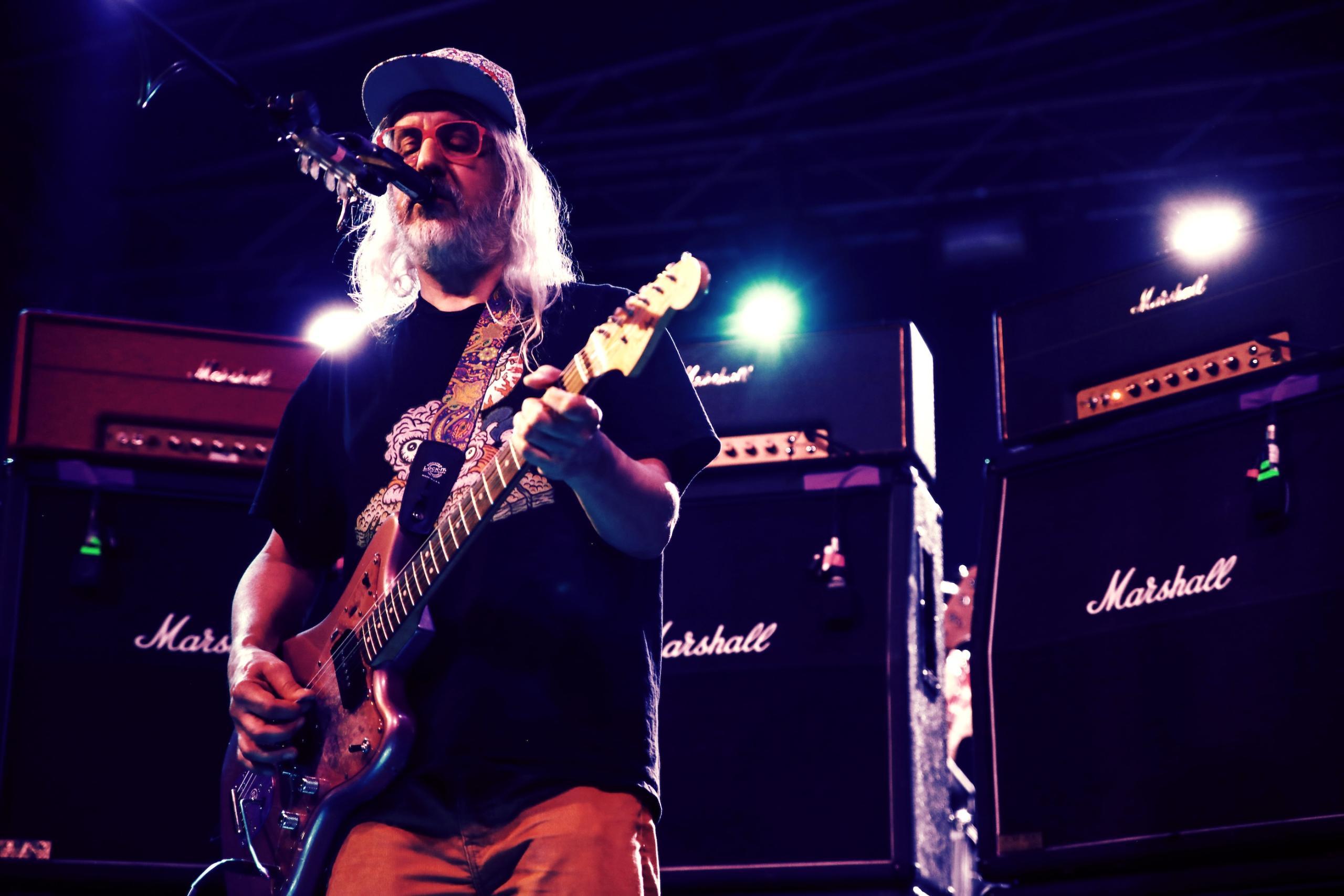
Photograph courtesy of Valentina Ceccatelli. Published under a Creative Commons license.