Populist movements have reminded their leaders to reconnect with ordinary people before it’s too late.
Now those people are right outside the door. They’re asking for more teachers, affordable homes, functional public services and an end to their governments’ complicity in the destruction of Gaza. And they want answers.
The challenge is whether parties accustomed to commissioning research into popular disaffection can recognise it when it arrives unannounced.
This autumn’s mobilisations are neither a single movement nor a ready-made electoral coalition.
Students defending education, tenants resisting eviction, workers protesting living costs and Palestine solidarity activists have different organisations, experiences and immediate objectives.
Although membership in these groups sometimes overlaps, they are not guaranteed to stay together. But they are beginning to contest something larger than a collection of unpopular policies. Their target is a society in which security is increasingly reserved for property, while people must cope with precarity.
The nationalist right has made a substantial political investment in claiming ownership of popular anger. These new protests suggest that this is still wishful thinking.
The European left should consider the possibility that its historical constituency includes people who aren’t likely to be invited onto television panels to explain why they voted for the far right.
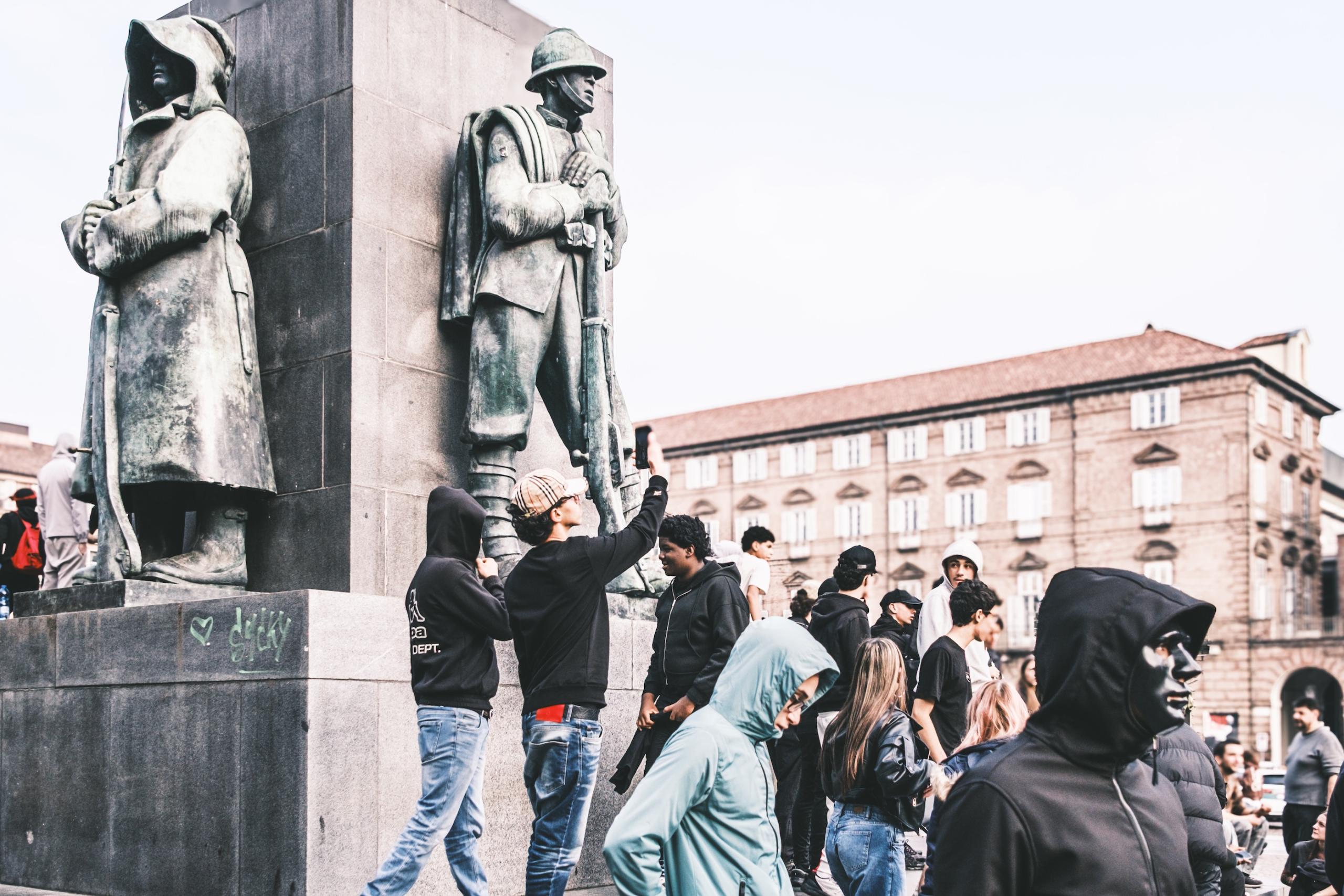
At last Saturday’s demonstration in Torino, Battleground Editor-in-Chief Joel Schalit spoke with young protesters dressed in black as they confronted a line of Carabinieri in full riot attire. Many were immigrants from North Africa and the Middle East. They later clashed. The protesters’ anger was unmistakable, its political destination uncertain.
A familiar temptation is to read such scenes as either proof that civilisation has collapsed or as evidence that revolution is progressing nicely. Both readings substitute costume for politics.
A conversation at one demonstration falls short of a sociological census. But the encounter raises a question that respectable discussions of Europe’s future routinely evade: where, within that future, do these young people belong?
They are frequently discussed as problems of integration, public order or demographic management: objects of social engineering, in other words. Here they were asserting their right to act as political subjects, participating in a struggle over the conditions of collective life.
The European left must acknowledge and respect this agency.
However, it must also be mindful of how easily it can turn to resentful passivity. A black hoodie establishes neither a program nor an effective strategy. What matters is whether the anger acquires organisations, relationships and achievable objectives, rather than becoming an exhausting confrontation in which the state controls the terrain.
Developments since the weekend make it clear how high the stakes are.
On 20 October, Portuguese police cleared housing protest camps in Lisbon and Porto and made 55 arrests. Protesters returned to the squares, and a Lisbon assembly voted to pitch tents again. Their demands include withdrawing legislation that eases evictions and removing rent caps on new leases. The housing question has become a struggle over who can occupy the city, both residentially and politically.
Italy’s far-right government responded to the weekend’s disturbances with a new security decree mandating tougher penalties for “violent” participation in demonstrations. It also expanded preventive detention powers to cover some minors. And France was preparing a reinforced security operation ahead of further protests, while talks between the prime minister and unions produced no new announcements.
The political danger is that disputes about schools, rents and living standards become an extended referendum on demonstrators’ conduct.
Destroying shops and attacking people causes real harm, often for people who are struggling with precarity themselves. A movement needs the capacity to argue against such tactics. But it also must insist that such behaviour be placed in context.
The strongest evidence that a different politics is emerging comes from the connections participants are making themselves.
In Milano, students have mobilised over education, transport and accommodation costs, racism, military spending and Palestine. These connections are practical before they are theoretical.
Consider the response of the Rete degli Studenti Medi to Italy’s school decree. The disputed measure introduces a ceiling for pupils entering first-year classes who lack Italian proficiency and hold non-Italian citizenship.
The student organisation’s answer is straightforward: language difficulties call for investment in teaching and services. Separating pupils according to citizenship will not provide the missing resources.
Here is an opportunity for the left to counter right-wing narratives.
When public institutions struggle, one response is to improve them. Another is to restrict who is entitled to use them. The latter spares governments an awkward discussion about money, staffing, and responsibility. The ceiling may still leak, but at least everyone knows who belongs in the classroom.
This is why the perennial instruction to choose between class politics and antiracism is so impoverished. Schooling, citizenship, housing and employment are already connected in people’s lives.
An employer’s ability to exploit insecure status, or a family’s difficulty obtaining accommodation, helps organise material inequality. A left that treats these questions as distractions from economics has adopted an unusually selective definition of the economy.
Turning individual protests into sustainable coalitions takes hard work.
A tenant does not automatically become an internationalist, just as a student defending public education does not automatically become a socialist. Shared grievances can produce solidarity, resentment or withdrawal. No spontaneous mechanism converts hardship into emancipation.
Gaza matters within this process because solidarity with its people has revived demands for political equality. European governments proclaim the universality of rights. Palestine solidarity movements point out the hypocrisy of this declaration when some people are not permitted to assert theirs.
The 10 October mobilisations across Italy illustrate this critique’s organisational potential. Palestinian associations and youth organisations helped convene demonstrations supported by unions, student collectives and political groups. This created opportunities to meet, organise and act together.
Palestinians have their own political demands, and solidarity with them must stand on its own merits. It cannot depend on whether their suffering helps the European left improve its domestic prospects.
Equally, a movement organised around equal human worth needs to oppose Antisemitism and the celebration of attacks on civilians. Its universalism becomes credible only if invoking it might be uncomfortable.
For young people who experience both exclusion at home and indifference toward Palestinian lives abroad, the connection may be particularly immediate. We should investigate that experience rather than prescribe it to everyone of Arab background.
Political belonging can grow through defending someone else’s rights, as well as demanding one’s own.
France shows how this broader politics can gain institutional strength. An education inter-union statement on 9 October coupled support for students’ demands with demands over employment, wages and working conditions. Students’ experience of absent teachers and deteriorating buildings met workers’ experience of understaffing and declining conditions.
Such connections require support less photogenic than an appearance at the head of a march: meeting rooms, transport, legal assistance, strike funds, experienced stewards, and people who return after the cameras leave.
The Confédération générale du travail (CGT) trade union has explicitly affirmed that students should determine their own demands and mobilisation. This is a useful principle for parties too. Young people entering political life need opportunities to exercise judgement and responsibility. A democratic movement develops through decision-making, including decisions its allies would have preferred it to make differently.
All this is practical education. Sustaining a strike or occupation means arranging food, resolving disputes and deciding what a concession is worth. These activities can make solidarity into a habit rather than a declaration.
La France Insoumise (LFI) has understood the importance of taking a visible position. Its support includes concrete demands over staffing, university admissions and affordable student meals, alongside opposition to repression.
Whatever one’s judgement of the party, this gives solidarity a recognisable political content. It offers students something more substantial than congratulations on their engagement, followed by a request to unblock the entrance.
It isn’t only the radical left that has recognised the importance of creating opportunities to channel the energy of recent protests into sustainable organisations.
France’s Parti socialiste (PS) has backed mobilisation, demanded education funding and opposed injurious crowd-control practices. In Italy, Partito Democratico leader Elly Schlein has insisted that violence must not be used to silence people protesting unaffordable living costs.
The harder test is still to come. Will parties defend public investment when securing funding requires confronting powerful interests? Will they defend the right to protest when protesters also criticise them?
Spain’s Partido Socialista Obrero Español (PSOE) offers both an opening and a warning. Recently resigned President Pedro Sánchez has explicitly credited housing mobilisation with creating a path for political action, and has described legislation as a possible result of social pressure.
That recognises a relationship the left ought to cultivate: organised demands can expand what governments consider possible. But a governing party’s account of its responsiveness remains a claim to be tested against legislation, implementation, and tenants’ lived experience.
Meanwhile, Spain’s radical parties have provided an unfortunate reminder that proximity to social movements does not abolish organisational self-interest. Talks over a common electoral front broke down amid disputes about candidate selection. Separate lists risk dividing support under an electoral system that can penalise smaller parties.
None of this makes electoral politics dispensable. Institutions make budgets, employment protections, and housing rules, and they have powers a demonstration does not. Nor does it make the street a preliminary exercise whose participants should go silent once voting begins.
Movements can create pressure and knowledge that parliamentary organisations lack. Parties can help secure changes that movements cannot enact alone. Their relationship needs accountability in both directions.
Parties should also resist the comforting division between sensible demands and supposedly extraneous radical ones. It is perfectly legitimate to debate priorities, costs and tactics. But a coalition cannot be built by telling its least secure members that their rights must wait until everyone else feels reassured.
A left that promises to resolve every grievance without disturbing anyone powerful will eventually be forced to explain why the people who must remain patient are always those already struggling.
The opportunity confronting the European left right now is substantial precisely because the outcome is not pre-determined. A protest wave can build confidence and durable organisations. It can also end in exhaustion, repression and intensified suspicion between people who briefly marched together. The challenge is to leave participants stronger: secure a material gain, defend someone’s rights, widen an organisation, establish a relationship that survives the next disagreement.
Idealism is the enemy of this goal.
The left will never find a constituency cleansed of conflict, impatience, and awkward demands. It needs to work with the people who are already acting. They are making connections between the classroom, the workplace, the rented room and lives deemed expendable elsewhere.
Those connections could support a democratic alternative to the right.
Photograph courtesy of Joel Schalit. All rights reserved.