


It also offered a welcome counterpoint to reports that delegitimise the protests by focusing on property damage rather than peaceful demonstrations.
Surely, if people peacefully playing acoustic instruments were subject to such treatment, the story of the protests must be more complicated than a conflict between lawless anarchists and the beleaguered police doing their best to maintain order.
Watching musicians from L’Orchestre du Nouveau Monde play La Marseillaise, the “Ode to Joy” from Ludwig van Beethoven’s Ninth Symphony, or the song “The Hanging Tree” used in the Hunger Games films is a more palatable spectacle for the general public than the mask-wearing rappers of BORO 700, whose track “MRH” had often been played by students who represent the banlieues where immigrant cultures feature prominently.
Playing “MRH” over clips of masked young people looting stores is bound to create a very different impression than the sight of people fleeing tear gas with clarinets and cellos in their hands. Choosing one over the other carries major ideological implications.
The wave of student-led protests springing up across Europe does not have a homogeneous soundtrack. Local tastes play a role. But so does how quickly local tastes can go global.
Laments about the decline of protest music, how there are no longer era-defining songs emerging from unrest, fail to comprehend how technology has transformed our relation to sound. Even young people with little spending money have unprecedented access to music from different eras and places.
This access is helping create a new internationalism in the spatial register, and its equivalent in the temporal one.
Social movements try to connect the present with the past. That isn’t new. Even though giving the impression of historical continuity involves a lot of work, promoting it is important for reinforcing the movement’s sense of collective identity.
When I reflect on the many protests I attended as a university student in the San Francisco Bay Area in the late 1980s and early 1990s, I can now perceive how the movement veterans who helped to organise them were keen to make history come alive with music.
We played Public Enemy, N.W.A., and Metallica on the boomboxes we brought on marches; they led us in the gospel songs the American Civil Rights movement had turned into secular anthems. We turned up the volume to the point of distortion; they made sure we had drums, whistles, and megaphones exempt from the challenges of electronic amplification.
Reviewing coverage of the protests in France, Italy, Albania, Serbia, Spain, and Portugal, I noticed a similar effort to reinforce the excitement of the present moment by invoking tradition.
The Italian partisan anthem “Bella Ciao” was heard at many protests. So was “¡El pueblo unido jamás será venicdo!”, the Chilean song from the final year of Salvador Allende’s presidency that has come to represent the unquenchable desire for self-determination for the victims of political oppression. Hearing thousands of voices rising in unison is a wonderful antidote to the paralysing despair caused by personal precarity.
Reading a news story or watching a short television segment on protests is very different from experiencing them in real time.
For both commercial and ideological reasons, they focus on the most extreme behaviour. This leads to a search for pictures worth the proverbial thousand words, like a burning building or a cordon of police in full riot gear.
This approach to reportage gives the impression that the protests are unsustainable. That’s why we need long-form content to counterbalance it.
Historically, writing was the easiest way to accomplish this goal, because it can distil events that unfold over time into a few sentences and describe details that don’t lend themselves to compelling visualisation.
Documentary filmmaking offers an exciting multimedia alternative to writing. But no matter how hard directors try to avoid reducing protests to eye-catching scenes, the medium’s essence inevitably works against them. This is especially obvious right now, as AI is used to generate short clickbait videos cobbled together from excerpts from serious documentaries.
This is where field recordings can fill in the gap between writing and visual media. Because people worldwide respond intuitively to rhythm, they are willing to listen for evidence differently than they look for it.
Instead of fixating on a few indelible images in a way that suppresses their surrounding context, people who listen to the recording of a protest are far more likely to get a sense of its spatial and temporal scope. Size can be heard. And so can the rhythms that make it easier for a crowd to act in concert for hours on end.
Call-and-response chants hit differently when you aren’t distracted by the small percentage of a crowd in the foreground of an image. The distance between participants and, more importantly, the way they bridge it through sound stands out. So does the enthusiasm the speakers and the people responding to them convey.
The recording’s spatial dimension is paramount. The beating of drums, far away from the microphone, gives the impression of a gathering storm. This is why their presence at protests is so important. Their sound synecdochically communicates a rupture in daily routine and, with it, the promise of an end to the political drought the left has suffered in Italy and throughout much of the developed world.
To be sure, reinforcing protests through rhythm happens across the political spectrum. Whenever a group feels marginalised or disenfranchised, excluded from the benefits a government bestows, demonstrating its anger involves making noise together.
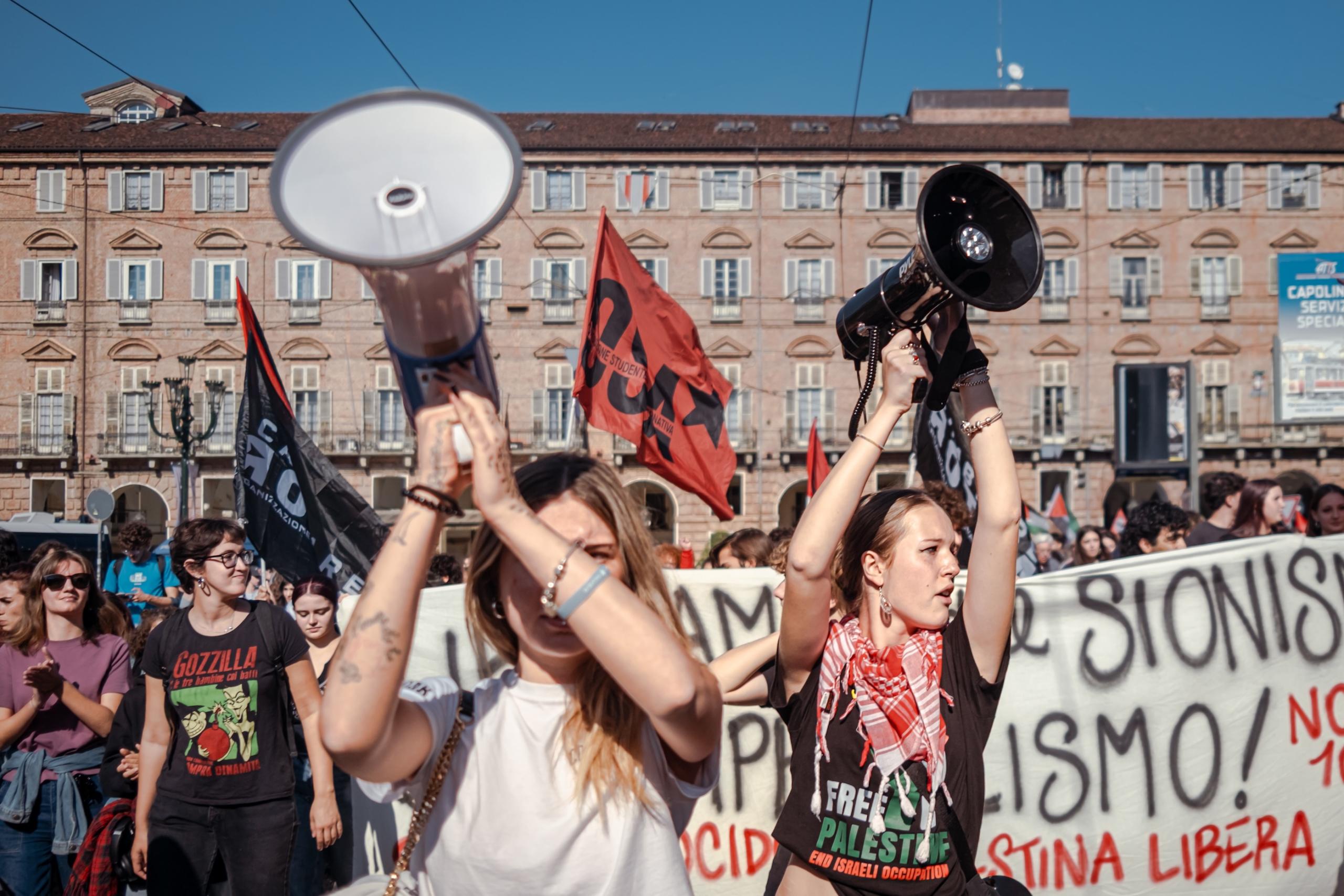
The desire for an audience, to get a fair hearing, is a foundational metaphor of the political sphere. In a protest like the recent Coravita demonstration in Torino, documented above, it is transubstantiated into a collective noise-making too powerful to be muted.
To some extent, it doesn’t matter what kind of music is played at a protest, as long as it motivates the crowd.
An apolitical song can be repurposed into a protest anthem.
That’s what happened during the Serbian student movement of the past few years with “Pumpaj”.
The original song was released in 2001 by the rap group 187. Although that was only three years after the NATO bombing of Serbia—inspiring great animosity towards the West—the lyrics completely avoid local political concerns.
That makes sense for a group named after the California penal code’s designation for murder, a reference that appears over and over in the gangsta rap from places like Compton. Unlike practitioners of “conscious” hip-hop, groups like N.W.A. articulated a vision of criminality as resistance.
Despite 187’s button-pushing name, “Pumpaj” doesn’t go that far. The gangsta bravado of their American influences is pared down to a celebration of car culture, describing a tricked-out ride with a subwoofer-enhanced sound system that can shatter windows.
It can be hard to tell why a protest movement adopts a particular song. But the parallels with sporting culture hold a clue. House of Pain’s 1990s rap hit “Jump Around” became hugely popular at American sporting events because it enjoins listeners to turn passive spectatorship into active support, inciting them to become a crowd capable of willing their team to victory.
For the young people who led the Serbian protest movement, “Pumpaj” reinforced a connection with their parents’ generation and, with it, memories of how the nation persevered despite isolation from the rest of Europe. More important, though, was the simple injunction—a staple of popular music culture for decades—to pump up the volume:
“The real thing is just to pump it, to hit the bass hard,” the lyrics insist. “So that the music can be heard long after us. Pump! Turn up that bass a lot. Come on, pump!”
The antisocial impulse to inflict excessive noise on innocent bystanders as an expression of individual power was transmuted into a profoundly social one.
To the surprise of many outside observers, the student-led protests in Serbia did not peter out in the face of the organisational challenges that often confound young people taking on entrenched authorities. Instead, they morphed into an electoral campaign that just defeated the nation’s long-time president Aleksandar Vučić.
Sound shatters glass when the pressure exceeds the breaking point. As a political metaphor, this knowledge can inspire a movement, as voices join into a chorus capable of destroying a regime.
The role of “Pumpaj” in the Serbian protest movement turned the government’s use of a sound cannon against protesters into an ironic gesture. As dangerous as such a crowd control weapon can be for those caught in its cone of volume, it was no match for the scope of the protests and the mounting pressure they applied to the status quo.
We live in scary times. The prospect of reaching the point of no return, whether ecologically, financially, or politically, confronts us with mounting urgency.
But we have to remember that, even when a situation looks hopeless, it might not sound that way.
No matter how much the mega-billionaires who dominate the headlines would like to believe they hold limitless power over us, the stirring words heard during protests across Europe are as true as ever: “The people, united, will never be defeated.”
Photograph courtesy of Joel Schalit. All rights reserved.


