


Of course, the idea that the nation has anything to restore is itself an invention of its reluctant 1865 lurch towards modernity: Ulysses S. Grant claimed his administration would restore the Union and redeem at least some promises made to freedmen and women, with the blood of hundreds of thousands of young soldiers.
Yet the full force of “American redemption” as a driving political narrative would not come until several years later, as opponents of Reconstruction would frame their attacks on Black rights and Radical Republicans as a crusade to “redeem” a lost Jacksonian white republic, evoking all the Christian connotations of the word.
Since the late 19th century, national redemption of one kind or another has been promised, launching us into the future, as Walter Benjamin famously said, in the clothes of the past: the New Deal and its redemption of the “Lincoln Republic”, Kennedy with his “New Camelot”, Nixon with the redemption of the “silent majority”, Reagan’s “Morning in America”, Obama’s promissory note of the civil rights movement’s “Hope and Change”, and, of course, Trump’s redemption of lost American “greatness”.
In a recent Guardian essay by journalism professor, New York Times columnist and Jewish Currents editor-at-large Peter Beinart, he proposes a new kind of national redemption, in light of US support for Israel’s genocide in Gaza. Calling it “progressive America First”, Beinart claims we can win voters to a less aggressive foreign policy by articulating American interests and American innocence.
Abdul El-Sayed, claims Beinart, won his Michigan primary by framing Palestinian rights in terms of American national sovereignty: aid to Israel “violates human rights” of Palestinians and, more importantly, “denies resources to Americans at home”. By “fusing [American] nationalism with progressivism”, Beinart concludes, he is answering Charlie Kirk, who wanted “American leaders to put their own country first” and not be led astray by our “current relationship with Israel”.
While El-Sayed has addressed neither Kirk nor the (new) America First movement, Beinart clearly wants to read El-Sayed as part of a long political tradition in which liberals can, in his words, “reclaim patriotism” and offer their own renewal of an American dream betrayed.
This is Beinart’s argument, not El-Sayed’s. I do not have special insight into El-Sayed’s innermost thoughts, but it is hard not to read his claims as serving a national interest in the context of his own contested claim to American belonging. As he would be the US’s first Muslim senator should he win, El-Sayed’s passport is at least discursively revoked by right-wing commentators on a daily basis, who label him a “terrorist”, a “security threat”, and a “jihadist”, and likely hope to revoke his citizenship literally.
While other Muslim politicians, such as Ilhan Omar and Zohran Mamdani, frame their solidarity with Palestine in less nationalist terms, for El-Sayed it is perhaps understandable that he should feel a need to assert a counter-nationalism to the GOP.
Yet Beinart wishes to do more than claim El-Sayed’s statements as a defensive measure. He argues they fit within the tradition of “patriotic liberalism” and must be read not only through the particularities of El-Sayed’s identity but also in a broader debate about Israel and “America First” anti-Zionism.
In recent years, there has been a surprising re-emergence of far-right criticism of Israel, now seemingly permanent. It’s never fully gone away – indeed, it was David Duke who coined the phrase “Zionist Occupied Government,” and The Turner Diaries imagines a white utopia on top of, among other things, an irradiated Tel Aviv.
However, since the Six-Day War and the New Left’s turn toward anti-colonial independence movements, it’s been politically the case that criticism of Israel has primarily emerged from an anti-colonial and human-rights left.
The ADL’s “New Antisemitism” thesis from the mid-1970s was so certain of this truism that it declared classic Antisemitism over on the right; all that remains is the fight against left-wing anti-Zionism, which the ADL more or less successfully rebranded as a form of anti-Jewish animus. This thesis has become such common sense within the Zionist establishment that noted Holocaust scholar Deborah Lipstadt could actually state with surprise after 6 January that Antisemitism is “there on the right, too“.
And yet the trio of far-right anti-Zionist voices – Tucker Carlson, Nick Fuentes, Candice Owens – have captured the imagination and a great deal of social media. In part it is simply novelty; in part, a kind of realpolitik. If the right is in power, then perhaps only the right can achieve a breakthrough.
Beyond pragmatism, however, is a real fear that lines between the right are beginning to blur; once out-of-bounds right-wing thought has found a way into progressive discourse, with left-adjacent figures such as Max Blumenthal embracing anti-vax conspiracy theories, and Norman Finkelstein appearing with Candace Owens.
Attempting to court the right has yielded no electoral results (unlike for the left), yet despite the fecklessness and danger of this approach, fascination with these figures has not subsided.
Special rapporteur for human rights Francesca Albanese appeared on Carlson’s show, as did Avraham Burg, the noted Israeli socialist and peace activist; far-right editor and Israel critic Curt Mills was invited recently to a Jewish left conference in Boston and given an extensive interview in Jewish Currents and on Peter Beinart’s weekly show.
Frequent media commentator Trita Parsi, of the Quincy Institute for Responsible Statecraft, has claimed repeatedly that Israel and its supporters “work against American interests” and the US is in the thrall of Benjamin Netanyahu.
The Racial Lineages of America First
The “America First” movement is, of course, not new: there may be an even longer tradition of far-right critics of US expansion than of left-wing anti-imperialism. It often comes as a surprise to learn that in the 19th and early 20th centuries, many of the most vocal opponents of US expansionism were also the most vocal racists.
These were not people concerned with the rights of those W.E.B. Du Bois called “the darker races”, but rather with the belief that overseas conquest and imperial alliances would ultimately contaminate US institutions by diluting what they regarded as the unique Anglo-Saxon mission of self-government.
As Eric T. Love writes in his comprehensive history Race Over Empire,”…so fierce was the opposition by many of the early founders of the Republic to the incorporation of non-whites into the polity” that the Louisiana Purchase “they feared would allow ‘two votes in the Senate’ for ‘Creole ignorance’ as ‘incapable of children of self-governance’”. While Whig papers simmered over Jefferson’s purchase of French Territory, the debate over the Republic’s racial nature exploded at the prospect of annexing part or all of Mexico after the US-Mexico War.
Georgia Senator John C. Calhoun, one of the most pugnacious champions of expanding slavery, recoiled in horror at the prospect of annexing territory from Mexico. “Ours is the government of the white man,” he railed, “the great misfortune of what was formerly Spanish America is to be traced to the fatal error of placing the colored race on an equality with white.”
Of course, this did not include territory inhabited by Native Americans. “Conquering many of the neighbouring tribes of Indians,” Calhoun clarified, is not the same as “holding them in subjection, or of incorporating them into our Union.” Mexicans were far too numerous – and far too Europeanised – to be exterminated in Calhoun’s view, but not so white as to be fit subjects for incorporation, even as subordinates.
Lest we imagine that Calhoun is simply an isolated extremist, Senator Charles Sumner regarded the proposition to annex the Dominican Republic in 1870 with an equal sense of horror and outrage.
Writing in the New York Herald, Sumner argued against seizing the island not on anti-imperialist principle, but out of revulsion at its inhabitants. The residents of the Dominican Republic are a “turbulent” and “treacherous race”, he wrote for the Herald, with the paper later noting with some understatement that Sumner “did not appear to have so high an opinion of the sable humanity found in these regions”.
Declaring the United States an “Anglo-Saxon republic” that can only “remain so by a preponderance of that race,” Sumner nearly single-handedly defeated President Grant’s attempt to annex the island nation, thereby slowing the growth of the US overseas empire for decades.
It should be clear that what Sumner objected to was not anti-democratic domination, but rather that the “filthy-looking Negroes” should be considered citizens of the United States by law.
It must be remembered that the man who coined the phrase Manifest Destiny, John L.Sullivan, was far less racist than many of his white contemporaries (although this by any objective standard would be a fairly dubious point of comparison). As with many Enlightenment thinkers, Sullivan believed in universal human development and thus looked without fear at incorporating people he deemed less civilised.
Indeed, one of the most vocal advocates and key architects of an expansionist US empire was William Seward, secretary of state under Lincoln. Seward’s plans were ambitious, envisioning the transcontinental railroad as only the beginning of a continuous imperial archipelago across the Pacific, before gobbling up the islands of the Caribbean.
Seward imagined the continental empire eventually incorporating all of Canada and finally bringing Mexico in as a US state. Seward, a prominent abolitionist, opposed slavery, which he argued made the task of US expansion “impossible.” Not only did slavery weaken the United States, but it would also make US incorporation of lands in the global south unpalatable at home and spark resistance abroad.
For Seward, there was no contradiction between opposing racism at home and projecting US power across the world, because with slavery abolished, America would be, in his famous phrase, an “empire of liberty”. Indeed, Seward opposed the southern “black codes”, and the Chinese exclusion acts on the grounds that they harmed America’s standing as a global power. Imperialism, in short, was another name for abolitionism for Seward.
As Immanuel Wallerstein reminds us, racism is not as it’s usually framed, a system of exclusion, dislike, or aversion. It is often, rather, a system of inclusion and incorporation.
As Barbara Fields famously quipped, if the goal of slavery was segregation, white plantation owners would not have gone to the trouble of stealing Africans and forcing them to work in the New World. In this sense, the United States has long been constituted by competing racisms.
These include the genocidal and despotic white nationalism of a Calhoun or an Andrew Jackson, and the cosmopolitan and inclusionary racism of a William Seward or even the young Walt Whitman, who celebrated the conquest and annexation of Mexico when he was a cub reporter for the Brooklyn Eagle.
If the primary figure of the former kind of racism is the Indian-killer and slave-master of antebellum America, the latter is Uncle Sam and the white schoolmistress of the US’s grand imperial age. As Love points out, a dominant image in cartoons of the US occupation of the Philippines was not only the soldier but also the white schoolteacher, the hero of the abolitionist literacy crusades after the Civil War.
That liberal imperialism is also racist should not lead us to think that America First is either anti-racist or even anti-imperialist. They are competing forms of American power and domination, both dangerous in their complex, if parallel, ways.
Yet precisely because many of the architects of the US empire proposed it as a form of enlightened cosmopolitanism that we often imagine right-wing nationalism is itself not imperialism but a form of “isolationism”.
Charles Lindbergh, the man who popularised “America First” as “isolationism”, is long remembered for his 1941 speech in which he claimed “Jews” and foreign interests “were attempting to carry the United States into war with Germany.” He granted that Jews may have legitimate interests in opposing Germany, and yet, Lindbergh intoned, with what is perhaps his most Antisemitic assertion, it is Jewish control over the media, film, and political power that means Americans are at risk of falling for their designs.
Less well remembered, however, is an earlier speech by Lindbergh in which he divided the world into spheres of influence dominated by equal, if competing, imperial hegemons. “The Western hemisphere is our domain,” he said in 1939.
Latin American countries are “outposts of the United States”, and the US should “wage war with all the resources of our nation” if US control over Latin America were ever threatened. Further, he added, “our bond with Europe is a bond of race and not political ideology…it is the European race we must preserve; political progress will follow”.
Lindbergh was not anti-war; indeed, he was even less of an anti-imperialist. For Lindbergh, imperial domination over the hemisphere was part of the white man’s burden of American leadership. This is little different from his distaste for war in Europe: the fight, he correctly understood, was over the fate of Jews, Slavs, communists and colonial territory.
So long as one European power wins, the fate of these inferior races and their dangerous ideologies was of no concern to him.
What Lindbergh’s two speeches reveal, as does Calhoun’s fear of the full annexation of Mexico (he wanted only half), is that “America First” has little to do with opposing the American imperium. Calhoun was a fierce advocate for the expansion of slavery; he wanted it expanded only into territories where the full expulsion or destruction of indigenous inhabitants could be assured. Lindbergh’s concerns centred on sharing power: entering an alliance with Britain would expose the US to potential demands from Poles, Russians, and colonial subjects who might undermine the certainty of Anglo self-rule.
America First Beyond Gaza
Far-right figures such as Tucker Carlson and Nick Fuentes are contemporary expressions of a broader history of racist and ultra-nationalist criticisms of US foreign policy.
As Beinart himself notes in the NYT, Carlson believes that Israel will incite a “global religious war”, the victims of which would ultimately be “Christian, Western, white countries.” The real target of Israel is not the “mullahs in Iran” but “us”, which can be assumed to refer to white, Christian conservative Americans.
Fuentes similarly poses “Christ first, and America always” as against a Jewish state, claiming “the Jews are destroying this country because the country doesn’t want to support Israel anymore.” Now that “the Republican base is revolting” against Israel, Fuentes argues, “the Jews want to rip apart the Republican Party. And they want to cancel Tucker, and cancel me, and cancel Candace Owens, and they want to force JD Vance to make a stand on antisemitism”.
A candidate both Fuentes and Carlson have backed, James Fishback, refers to his Black Democratic opponent as “AIPAC Shakur,” while claiming he is “running…to make life more affordable for you and your family…America First not by the stock market going up, not by GDP going up, but how are average American citizens faring economically?”
Much like Lindbergh or Calhoun before them, their critique of foreign wars and imperial entanglements rests less on solidarity or internationalism than on a sense that the alliance endangers the racial character of the state: the world is preying on America, not the other way around.
While many focus on the Antisemitism of Carlson and Fuentes’ language and connect it rightly to their “great replacement” theories, which they believe Jews are also orchestrating, less attention is paid to asking whether or not their statements are actually true.
As American Studies scholars Melani McAlister and Amy Kaplan document, the US press and much of the Jewish and non-Jewish institutional world deeply identified with Israel’s lightning victory over Arab states, contrasting Israeli missiles blowing up Soviet jets before soaring over Africa to free hostages with “with images of Americans fleeing in helicopters from rooftops in Saigon”.
As historian Michael Fischbach notes, Americans regarded Israel post-1967 “like American” but “better” — “there were no draft dodgers in Israel”, Fischbach writes of the new pro-Israel consensus, and “no Vietnam War, no burning ghettos, no drug addicts, no crime”.
To many in the Pentagon, Israel had done by desert lightning-strike what years in the mists of Vietnam seemed impossible: knock out three Soviet-backed armies in a matter of days and set back Middle Eastern decolonisation permanently; Israel was the little capitalist state that could (defeat communism and anti-imperialism).
As sociologist Max Ajl frames it, “from 1970 onwards, US military aid into Israel turned the country into a unique asset: an offshore arms factory; a regional irritant to Arab peace, stability, and popular regional development; a destructive gyro of world-wide counterinsurgency; a black hole drawing in regional surpluses and devoting them to endless defensive and offensive armament, away from social-popular welfare spending and non-military development”.
It was precisely American “interests” that led the United States to support Israel, rather than a betrayal of them.
Israel’s strategic role in the American imperium and especially in what Andrew Bacevich refers to as “America’s war for the greater Middle East” continued through the 1980s and well into the millennium. Despite an arm’s-length disavowal and occasional differences in tactics, Israel has served not only as “America’s unsinkable air-craft carrier,” it has done so with a reliability and effectiveness that outdoes the US military and at a fraction of the cost for the US (indeed, most of the military aid given to Israel is recycled back into the US economy through weapons purchases).
From bombing Syrian and Iraqi nuclear reactors, assassinating Iranian scientists and military leaders, assassinating Hezbollah members, and running weapons to apartheid South Africa and the Contras, the US has got more than its money’s worth in the bargain.
This is what both America First and liberal imperialists have always occluded: American power, from its hundreds of military bases circling the globe to its grip on global currency and capital flows, is not despite its foreign alliances and client states; it is enacted through them. And to those who believe there is an “empire of liberty” to be had without racism or genocide, it is important to point out that US investments in Israel are not separable from Israel’s place in the West’s own self-conception.
Perhaps it is Israel’s contrapuntal nature, at once a client and a regional hegemon, at once a nation of former victims who are now victimisers, at once imagined as a minority and yet at the same time as the coloniser par excellence, that not only condemns the project of Zionism as ultimately caught in an impossible series of contradictions but also exposes the contradictions and paradoxes of American imperialism itself. Human rights, democracy, and the rule of law are all witnessed at their very limits by Israel’s gratuitous violence and ethnic chauvinism.
The Limits of Liberal Patriotism
While I cannot know Beinart’s own motivations for embracing the idea of a “progressive America First”, there is a long history of Jewish patriotic anti-Zionism. Founded in the 1940s, the American Council for Judaism (ACJ) was the first Jewish organisation created specifically to oppose Zionism.
Politically and culturally conservative, the ACJ opposed Zionism initially on the grounds that Jews belonged only to one nation, the United States. Their opposition to Jewish nationalism was also inseparable from their assimilationism: only a religion of Jewish individuals, even an alliance with African-American organisations to champion civil rights, was regarded as too much a betrayal of their conservative individualism.
While the ACJ has been re-founded in recent years under a much more progressive, visionary leadership, its near total demise in the 1960s ironically coincided with a Jewish left-wing upsurge of anti-racist and anti-imperialist activism, from the many tens of thousands of Jewish members and leaders of Students for Democratic Society (SDS) to smaller Jewish socialist collectives such as Jewish for Urban Justice and the Chutzpah Collective.
While the ACJ produced remarkable leaders who developed a left-internationalism through direct contact with Palestinian intellectuals, such as Rabbi Elmer Berger, its early years reveal the limits of patriotic critiques of Zionism. The ACJ was not insincere; it misunderstood the nation to which it pledged loyalty.
The Zionist project, with its racialised settler-mythologies and practices of militaristic conquest and domination, is not a betrayal of American ideals; it is a fulfilment of them, at least in its current political iteration. When the United States, precisely out of its sense of not only national interest but also national identification, forged a full partnership with Israel, the ACJ was left on the sidelines.
At that moment, the anti-imperialist left – including SDS and the Black Panther Party – began to see that Vietnam and Palestine were part of an archipelago of resistance to US imperialism.
Martin Luther King Jr. came to a similar conclusion in his famous “Time to Break the Silence” speech in 1967. “There is something seductively tempting about stopping there and sending us all off on what in some circles has become a popular crusade against the war in Vietnam…I wish to go on now to say something even more disturbing. The war in Vietnam is but a symptom of a far deeper malady within the American spirit…such thoughts take us beyond Vietnam, but not beyond our calling.”
Replace the US invasion of Vietnam with the genocide in Gaza, and one could reach the same conclusion. There is something tempting in the idea that if the US were to end its relationship with Israel, we could return to a less aggressive foreign policy, even a democracy.
There is no less aggressive foreign policy to return to. Whatever it may be, we must imagine it in the future and bring it about by reimagining not only human rights law and enforcement, but also the role the US may play in the world and at home.
Cutting off funds to Israel for its human rights abuses, sanctioning its arms industry and credit, seizing its offshore assets, and arresting its leaders are a moral imperative and a necessity: Israel needs to face real and lasting consequences for its violations of Palestinian life, dignity, and freedom.
Perhaps that is the only way to force the Israelis – at the risk of total isolation – to recognise the rights and self-determination of Palestinians. And in doing so, the US might be able to begin the long road of examining what got us here.
There was an old saying during the Vietnam War that the Ho Chi Minh Trail started with the Trail of Tears, suggesting that the anti-colonial insurgency in Vietnam against the US began much earlier in US history, in our colonial architecture in the years before and after the founding of the country.
The analysis is now as much conjunctural as it is historical or moral: many serious analysts thought that, for all his racism, Trump might be more willing to put brakes on Israeli aggression than Biden, with his “bear hug” of Netanyahu. Yet no amount of far-right commentary has been able to change more than one or two Republican votes on the most limited restrictions to Israeli aid.
The grassroots, and to a lesser extent representation in Congress, have all been on the liberal-left. Support for far-right figures, or even their rhetoric, only serves to fracture left coalitions, who might correctly hear that their own concerns for safety – whether trans, Jewish, or Muslim – are of second order.
These are not merely speculative concerns. None of the right-wing figures who have spoken out against Israel’s genocide or ongoing apartheid has called for an end to the deportation of Palestinian-American activists such as Mahmoud Khalil or Mohsen Mahdawi.
Carlson and Fuentes’ anger stems from a foreign power having hijacked American foreign policy, and, along with it, contaminated American democracy with suspect and alien bodies, ideologies and cultures. To say such fights are transnational, or that democracy at home is inseparable from human rights and anti-colonialism abroad, is not just a talking point: immigration policy and anti-colonialism are part of the same global imaginary of internationalism.
To put it another way, Israel is not stabbing us in the back: it is our bourgeoisie, many of whom are Zionists, who are stabbing us in the front, with endless wars, austerity, and declining standards of living, even life expectancy.
If we are to think of a domestic politics that addresses US imperialism, the necessary question is less how Israel came to control American politics than how a US empire came to see Israel as its necessary partner in the Middle East.
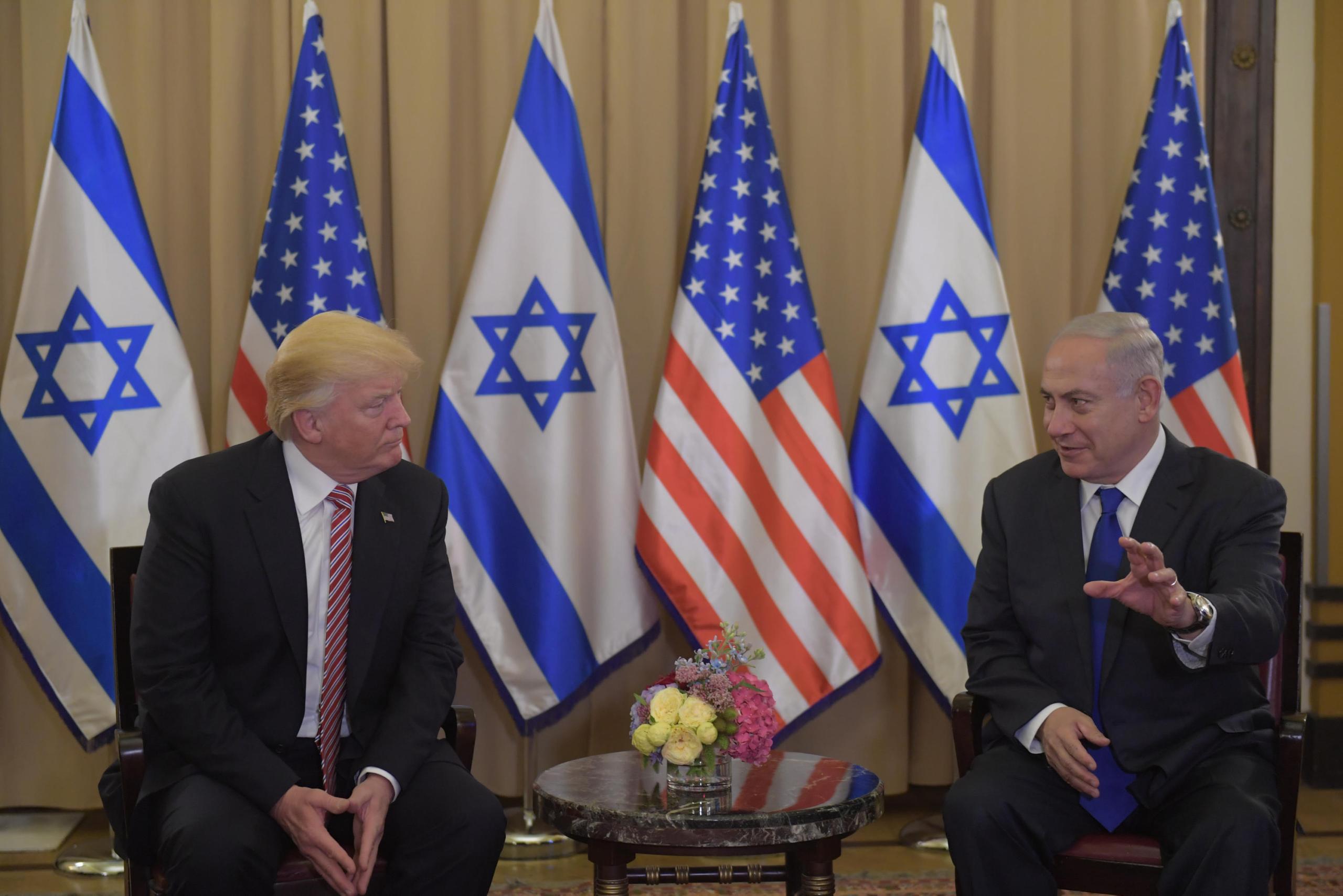
Photograph courtesy of Israel Ministry of Foreign Affairs. Published under a Creative Commons license.


